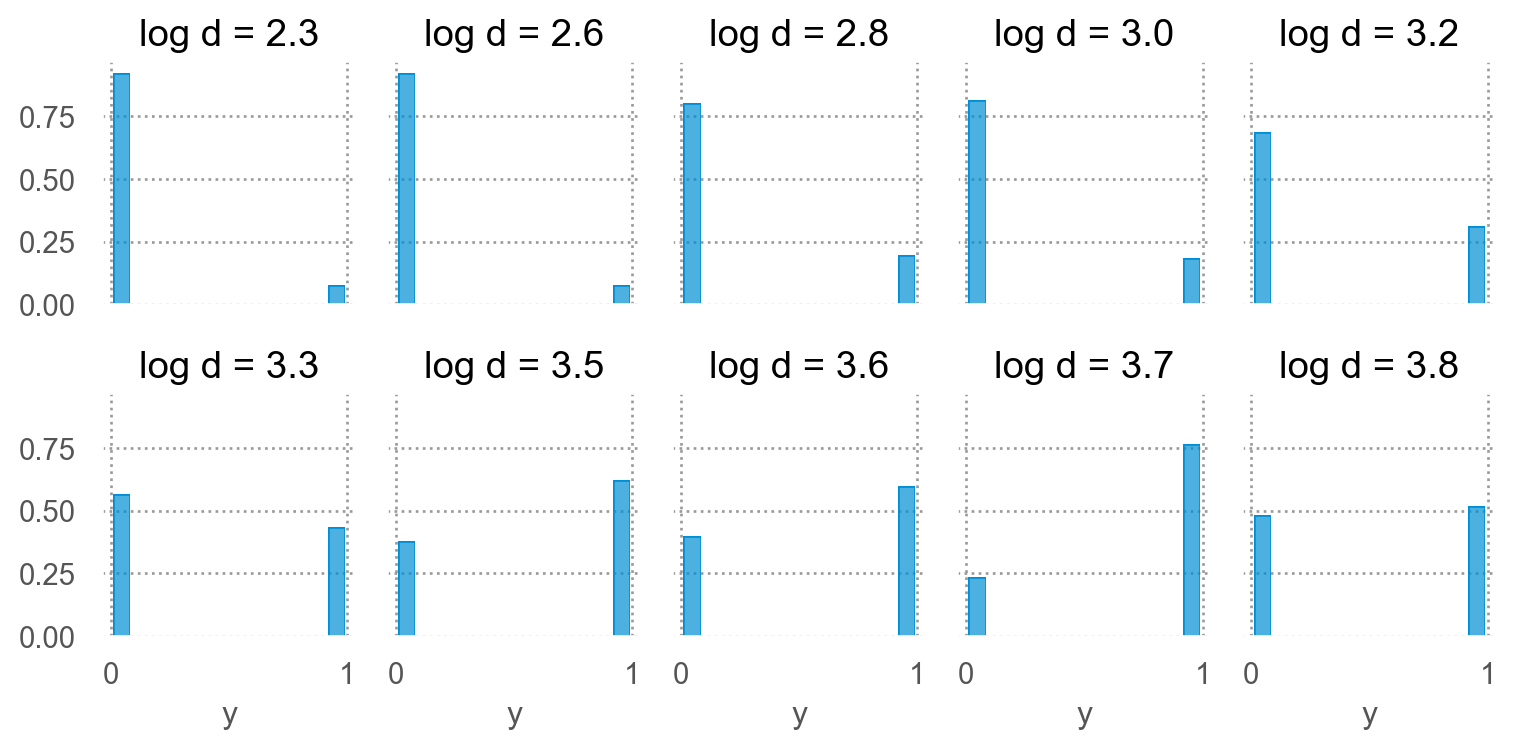
Emperical probability/ Odds
이제 y를 직접 예측하기보다, 확률을 예측하는 방식을 취하면,
각 두께를 가진 나무들의 개수 (m)와
그 중에 태풍으로 죽은 나무의 수 (died)를 고려하면,
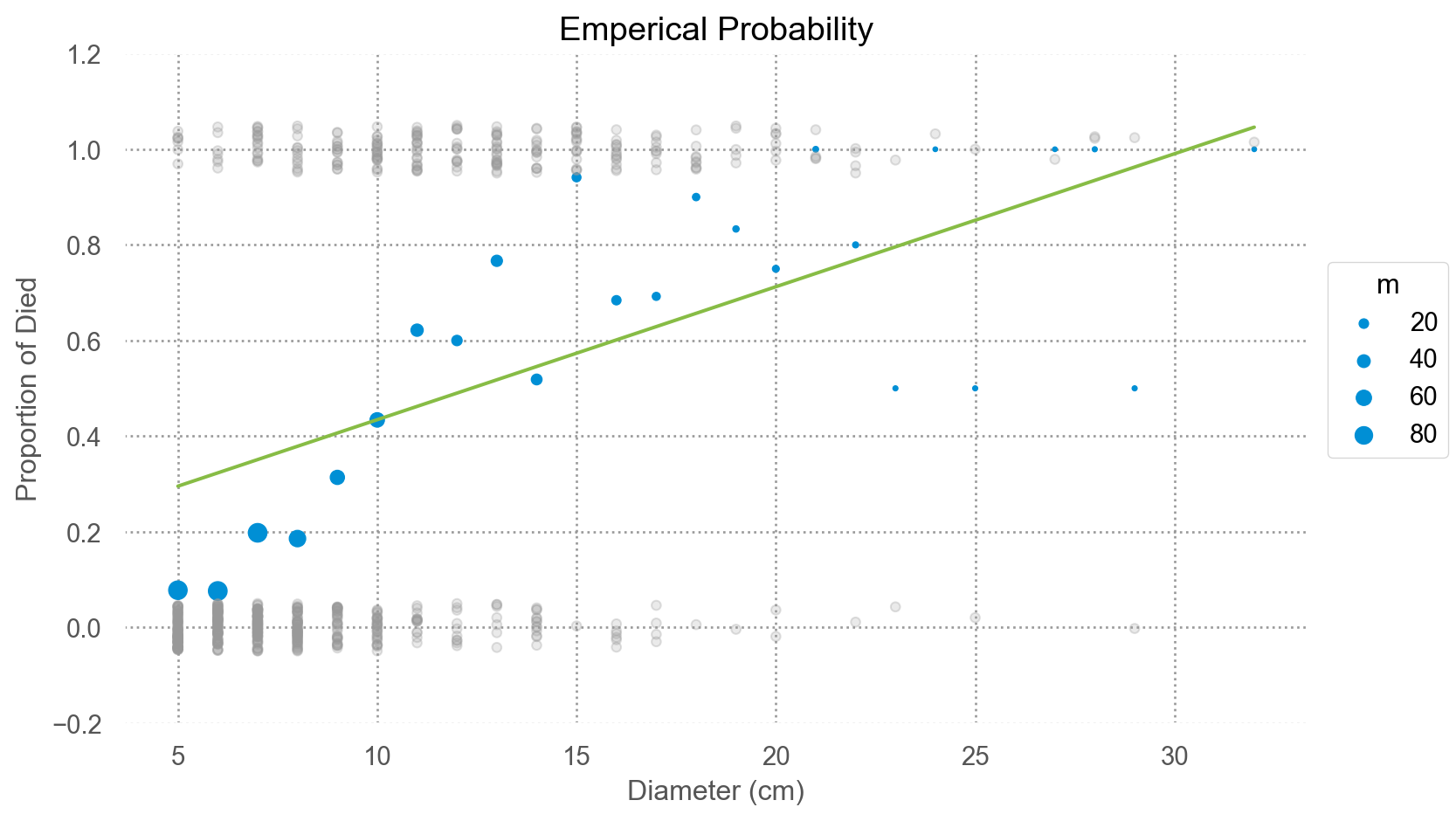
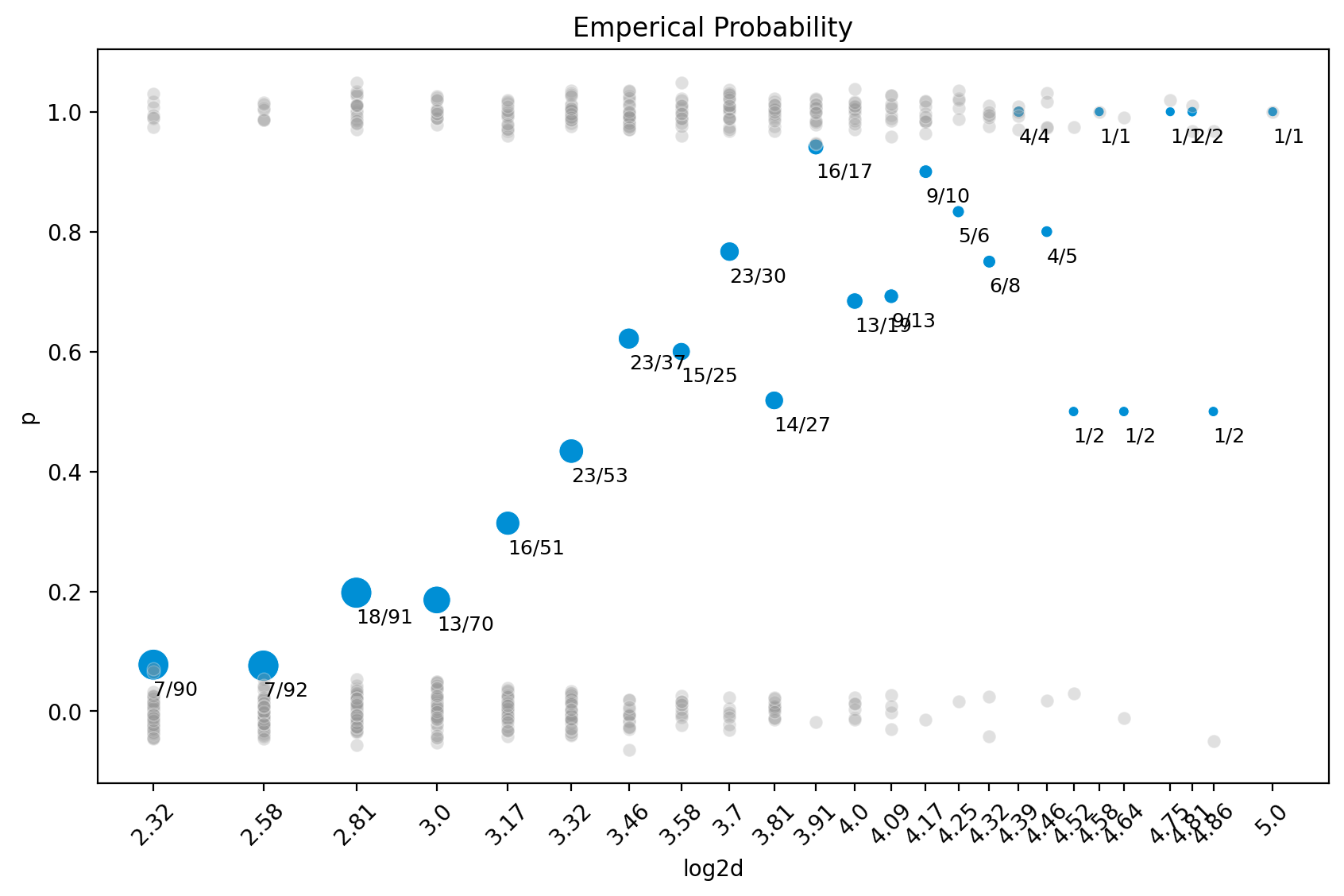
나무의 두께에 따라 죽은 나무 수의 비율 (p= died/m)을 계산할 수 있음. 이를 emperical probability라고 함.
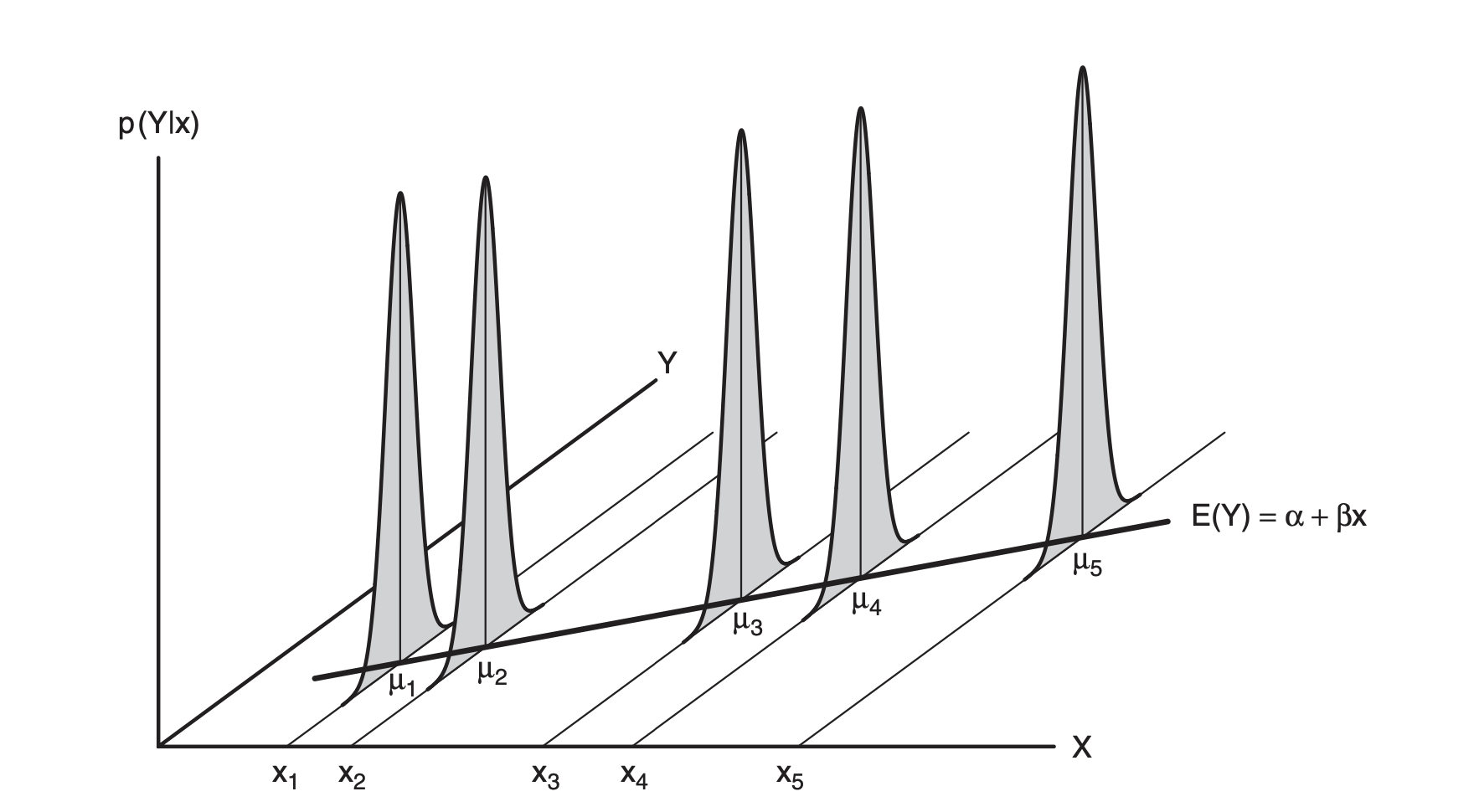
사실, 이 p는 binary response (0, 1)의 conditional mean(평균)인데,
통계적으로 표현하면 \(E(Y|d=d_i)\) 이며 선형모형의 mean function를 제공.
= blowbs.groupby("d" )["y" ].agg([("died" , "sum" ), ("m" , "count" ), ("p" , "mean" )]).reset_index()
       d  died   m    p
0   5.00     7  90 0.08
1   6.00     7  92 0.08
2   7.00    18  91 0.20
..   ...   ...  ..  ...
22 28.00     2   2 1.00
23 29.00     1   2 0.50
24 32.00     1   1 1.00

[25 rows x 4 columns]
code
= 'd' , y= 'p' )= 'm' )= .3 , color= ".6" ), so.Jitter(y= .1 ), x= blowbs.d, y= blowbs.y)# .add(so.Line(), so.PolyFit(5)) = "#87bc45" ), so.PolyFit(1 ))= (- 0.2 , 1.2 ))= (8 , 5 ))= 'Emperical Probability' , y = 'Proportion of Died' , x= 'Diameter (cm)' )
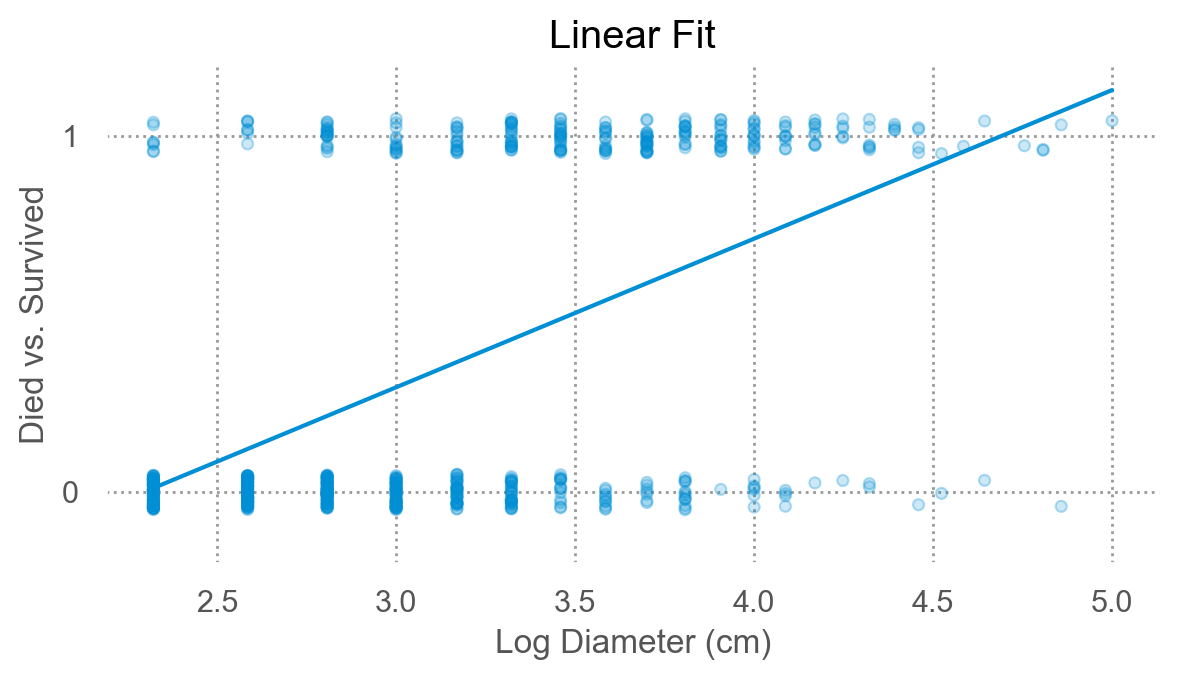
OLS estimate으로도 충분한가?
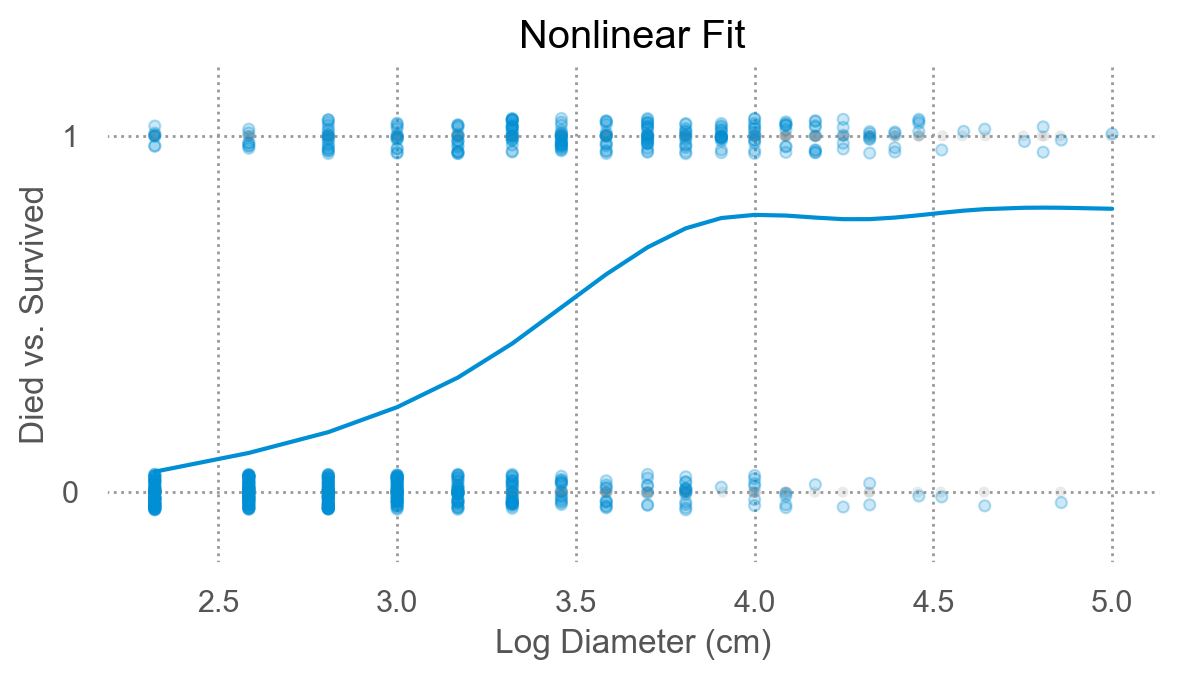
1차보다는 고차 다항함수로 fit한다면?
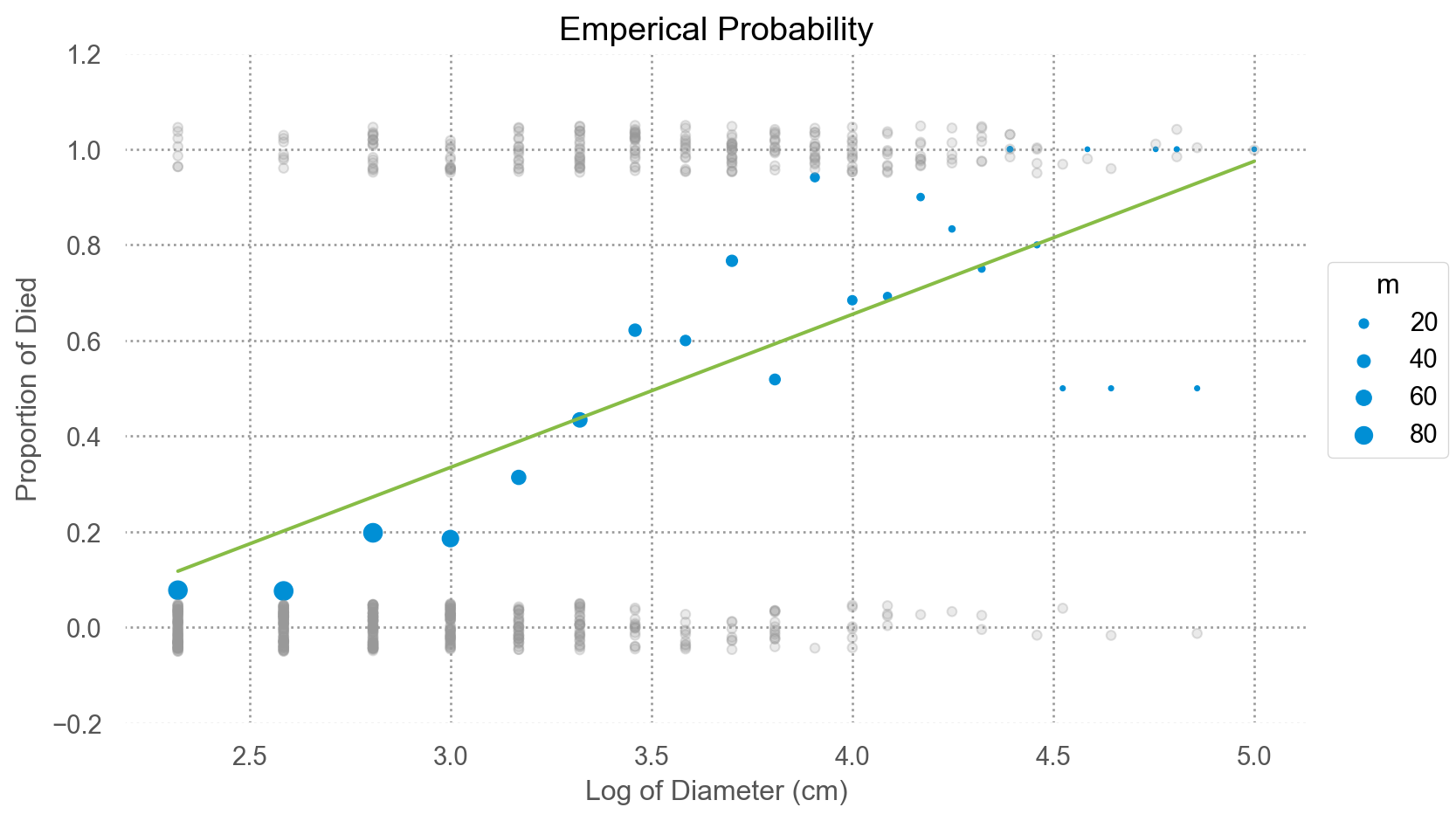
우선 d를 log2 변환해서 살펴보면,
code
"log2d" ] = np.log2(blowbs_bn["d" ])= 'log2d' , y= 'p' )= 'm' )= .3 , color= ".6" ), so.Jitter(y= .1 ), x= blowbs.log2d, y= blowbs.y)= "#87bc45" ), so.PolyFit(1 ))= (- 0.2 , 1.2 ))= (8 , 5 ))= 'Emperical Probability' , y = 'Proportion of Died' , x= 'Log of Diameter (cm)' )
위에서 살펴본 OLS의 문제들 즉,
잔차에 패턴이 보인다는 것은 충분히 좋은 모형이 아니라는 것을 의미하고,
예측값이 확률을 의미하지 못할 수 있음.
잔차의 분포도 Gaussian과는 거리가 멈.
이런 문제들을 해결하고 예측값이 분명한 “확률”의 의미를 품도록 여러 방식이 제시되는데 주로 사용되는 것이 logistic regression임.
Binary outcome을 예측하는 logistic regression 모형은 binary 값을 예측하는 것이 아니고, 확률 값을 예측하는 것임.
예를 들어, 두께가 5cm인 (특정 종의) 나무가 태풍에 쓰러질 확률(true probability)을 파악하고자 함.
이 때, 관측값은 5cm인 나무 중 쓰러진 나무의 “비율”이고, 이 관측치들로부터 true probability를 추정하고자 함.
Odds 의 정의: 실패할 확률 대비 성공할 확률의 비율
\(\displaystyle odds = \frac{P(Y = 1)}{P(Y = 0)} = \frac{p}{1-p}\)
예를 들어, 5cm 두께의 나무는 90그루 중 7그루가 죽었으므로 83그루는 살았음.\(p= \frac{7}{90}\) )을 이용해 계산하면, \(\displaystyle odds = \frac{\frac{7}{90}}{1 - \frac{7}{90}} = \frac{7}{90-7} = \frac{7}{83}\)
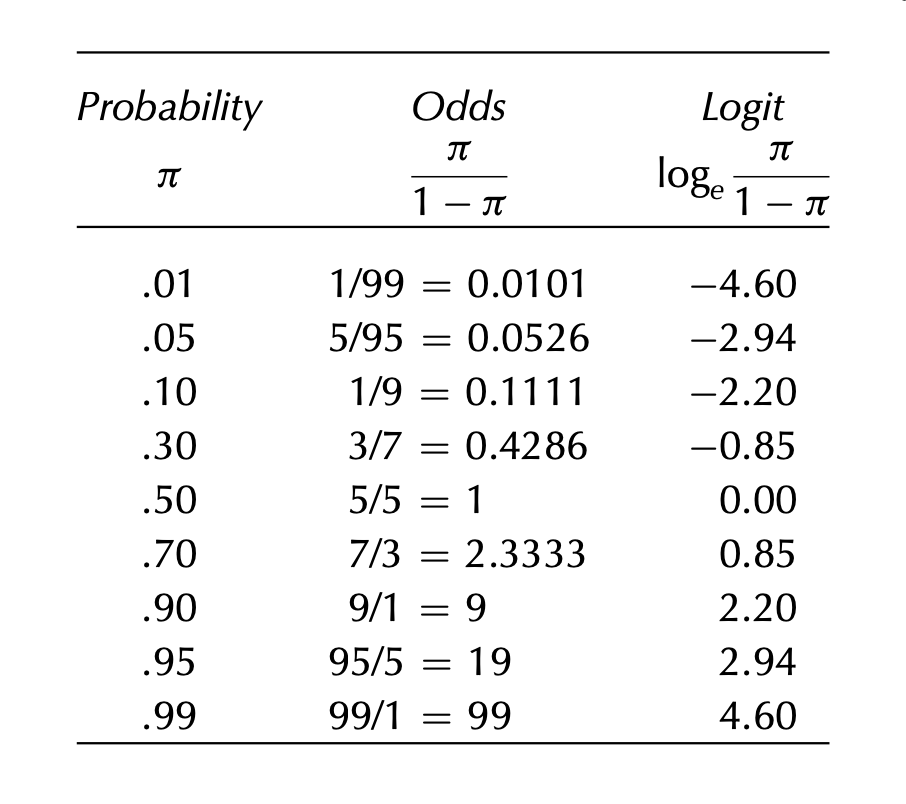
확률과 odds, logit(log odds)의 관계
= blowbs_bn.assign(odds = lambda x: x.p / (1 - x.p))# p = 1인 경우 odds가 무한대가 되므로 편의상 inf 값을 50으로 대체 "odds" ] = blowbs_bn["odds" ].apply (lambda x: 50 if x == np.inf else x)
       d  died   m    p  log2d  odds
0   5.00     7  90 0.08   2.32  0.08
1   6.00     7  92 0.08   2.58  0.08
2   7.00    18  91 0.20   2.81  0.25
..   ...   ...  ..  ...    ...   ...
22 28.00     2   2 1.00   4.81 50.00
23 29.00     1   2 0.50   4.86  1.00
24 32.00     1   1 1.00   5.00 50.00

[25 rows x 6 columns]
이 odds를 선형모형으로 나무두께로 예측하려고 하는 것인데, 예를 들어,
\(\widehat{odds} = b_0 + b_1 \cdot \log_{2} d\)
odds 값의 범위는 (0, \(\infty\) )이므로, 선형모형으로 fit하는 것이 적절하지 않음.\(-\infty\) , \(\infty\) )가 되어 선형모형으로 fit하는 것이 적절해짐.
이 때, 예측모형은 log odds가 \(x\) 에 대해 선형적으로 연결된다고 가정하는 것임. 즉,
\(\displaystyle \log \widehat{odds} = \log\left(\frac{\hat{p}}{1-\hat{p}}\right) = b_0 + b_1 \cdot \log_{2} d\)
이를 logit 함수로 간단히 표현하면; 전통적 통계에서 선호\(\displaystyle logit(\hat p) = b_0 + b_1 \cdot \log_{2} d\) , \(\displaystyle logit(x) := \log\left(\frac{x}{1-x}\right)\)
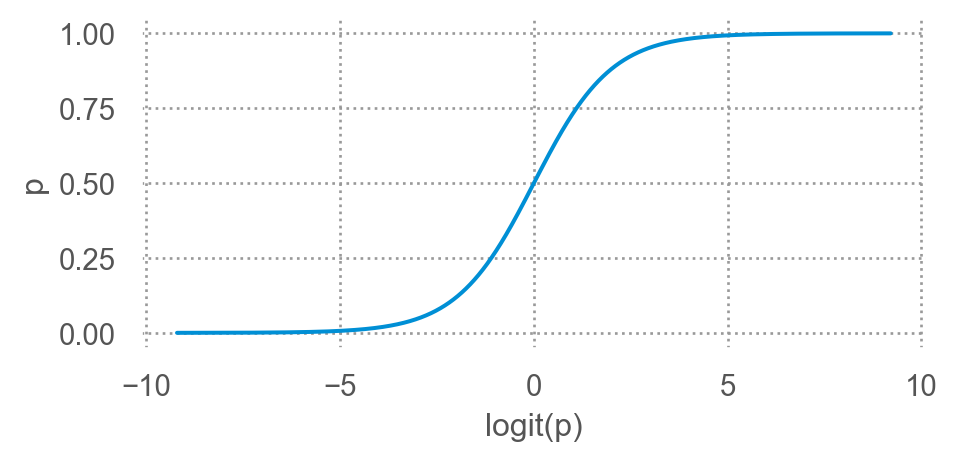
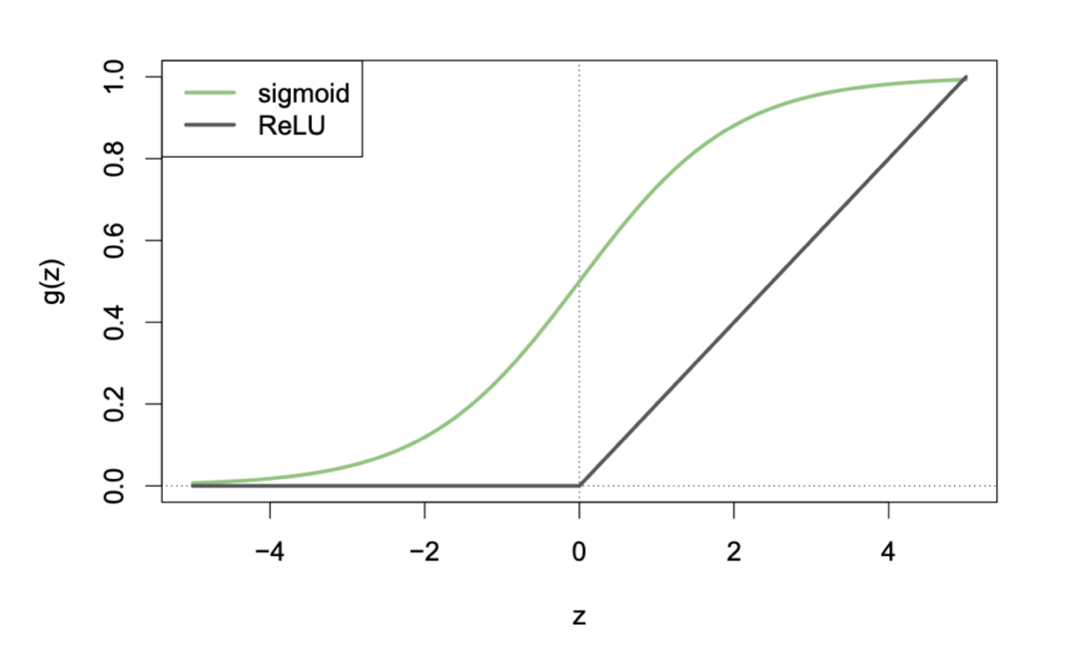
logit의 역함수인 sigmoid 함수로 표현하면; machine learning에서 선호\(\displaystyle \hat p = \sigma(b_0 + b_1 \cdot \log_{2} d)\) , \(\displaystyle \sigma(x) := \frac{1}{1 + e^{-x}}\)
이를 확률로 표현하면,\(\displaystyle P(Y=1|X=x) = E(Y|X=x) = \sigma(b_0 + b_1 \cdot \log_{2} d)\)
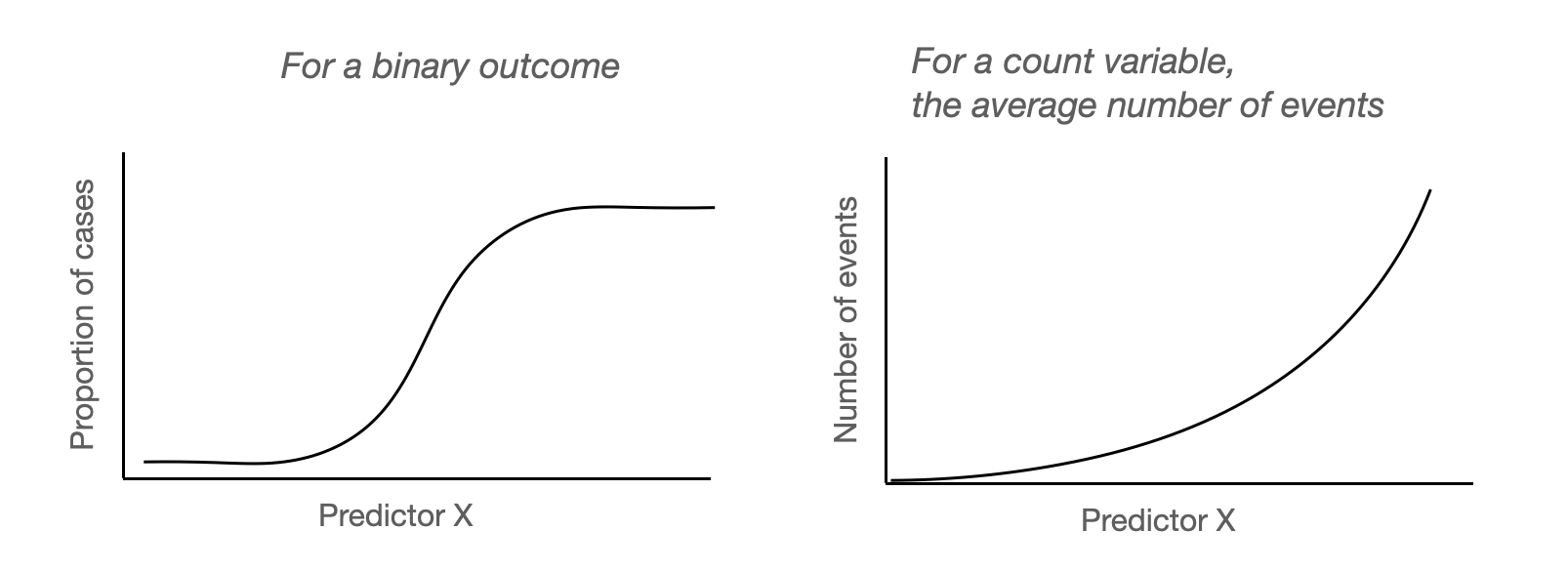
즉, logit은 예측변수 \(x\) 와 선형적으로 연결되는데 반해, 확률 \(p\) 는 예측변수 \(x\) 와 비선형적 관계를 맺음
Mean function \(E(Y|X)\) 을 변형하는 방식으로 표현할 때,
\(f(E(Y|X))=\beta_0 + \beta_1 X_1 + \cdots + \beta_n X_n\)
이 때, \(f\) 를 link function이라고 하고,
여기서는 logit 함수를 link function으로 사용함.
Machine learning에서는, 그 역함수를 이용해 선형함수 쪽을 변형해 다음과 같이 표현하는데,
\(E(Y|X)=f(\beta_0 + \beta_1 X_1 + \cdots + \beta_n X_n)\)
이 때, \(f\) 를 activation function이라고 부름.
여기서는 sigmoid 함수를 activation function으로 사용함.
sigmoid 함수는 logisitic 함수라고도 부름.
한편, 각 클래스 내에서 \(X\) 가 multivariate Gaussian 분포를 따르고, 이 분포의 covariance matrix가 (모든 클래스에서) 동일하다고 가정하면 (즉, 모든 클래스에서 분산과 공분산이 같으면),\(X\) 에 대해 선형적으로 연결된다는 것을 보일 수 있음: 즉, log odds를 선형함수로 모델링해도 되는 충분조건을 제공해줌.
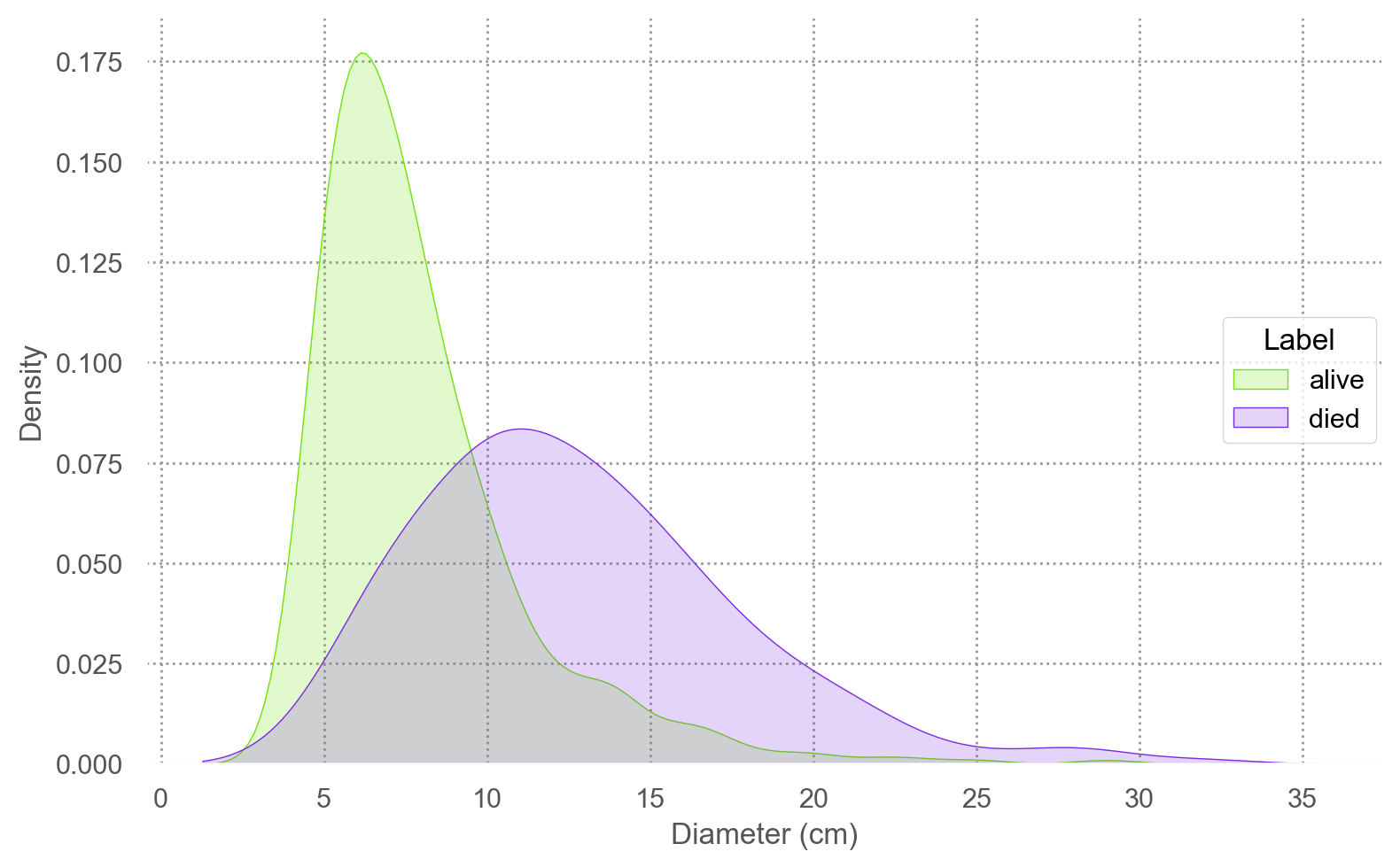
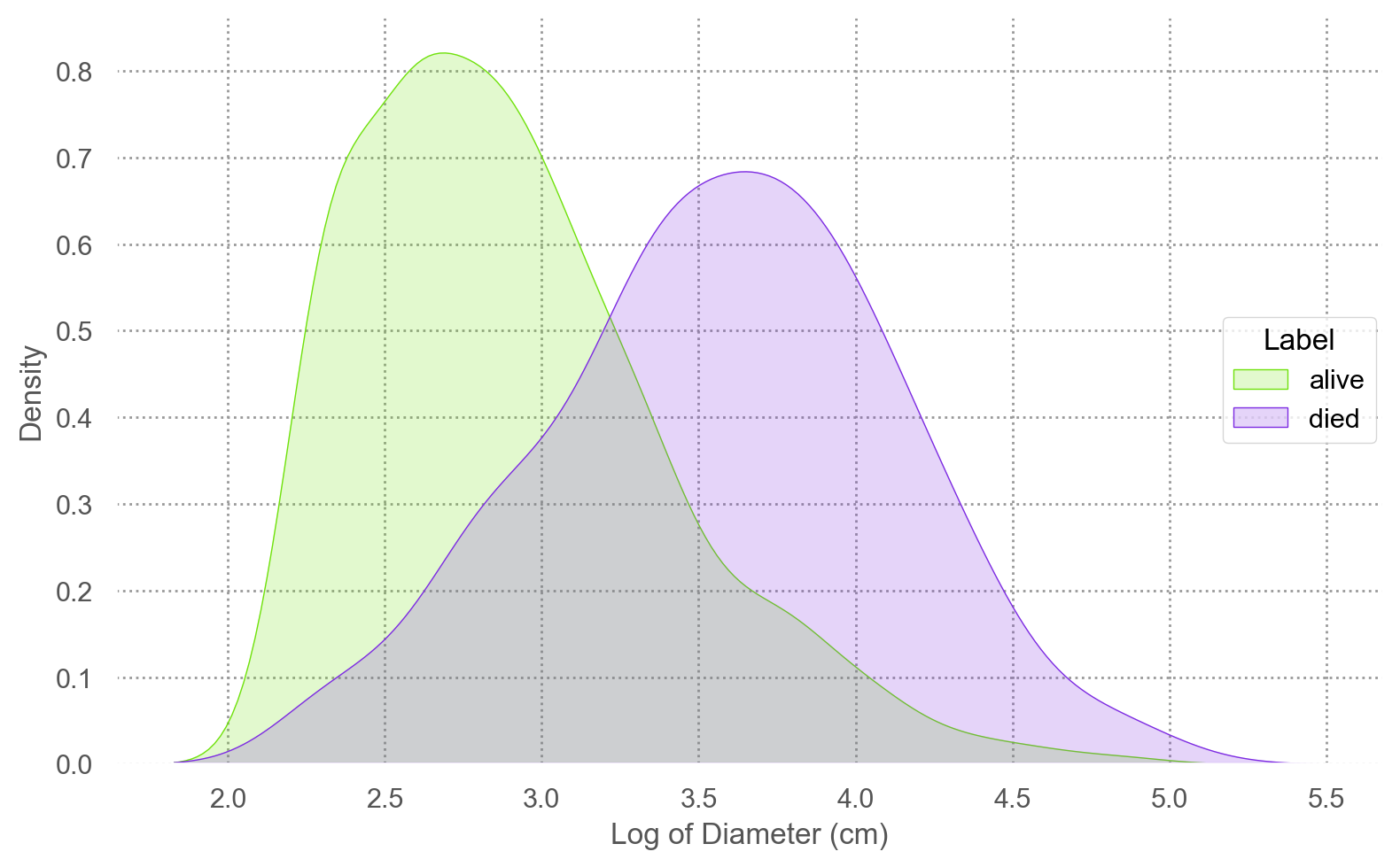
여기서는 쓰러진 나무와 산 나무의 두께가 Gaussian 분포를 따르고,
그 두 분포의 분산이 동일하다면(변수가 1개이므로 공분산/상관계수는 없음), log odds가 \(X\) 에 대해 선형적 연결될 수 있음.
나무의 두께(d)를 log2 변환한 이유임 (오른쪽 그림)
code
"label" ] = blowbs["y" ].map ({0 : "alive" , 1 : "died" })= 'd' , color= 'label' )= False ))#.scale(color=so.Nominal()) = ['#70e20c' , '#7d2be2' ])= (8 , 5 ))= "Diameter (cm)" , y= "Density" , color= "Label" )= 'log2d' , color= 'label' )= False ))= ['#70e20c' , '#7d2be2' ])= (8 , 5 ))= "Log of Diameter (cm)" , y= "Density" , color= "Label" )
이제, log odds을 구해, \(X\) 에 대해 선형적인 패턴이 있는지 확인해보면,
= blowbs_bn.assign(log_odds = lambda x: np.log(x.odds))
       d  died   m    p  log2d  odds  log_odds
0   5.00     7  90 0.08   2.32  0.08     -2.47
1   6.00     7  92 0.08   2.58  0.08     -2.50
2   7.00    18  91 0.20   2.81  0.25     -1.40
..   ...   ...  ..  ...    ...   ...       ...
22 28.00     2   2 1.00   4.81 50.00      3.91
23 29.00     1   2 0.50   4.86  1.00      0.00
24 32.00     1   1 1.00   5.00 50.00      3.91

[25 rows x 7 columns]
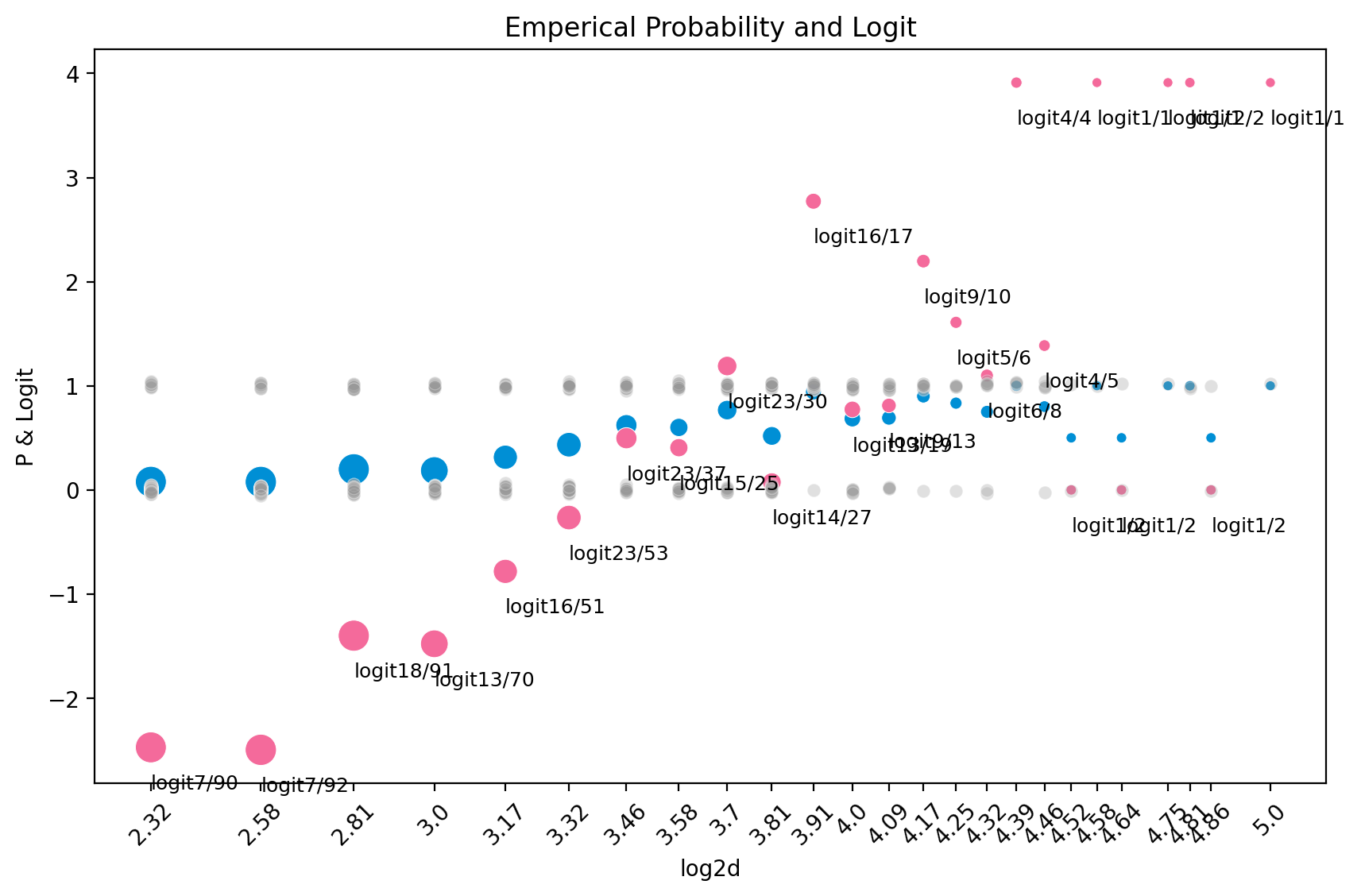
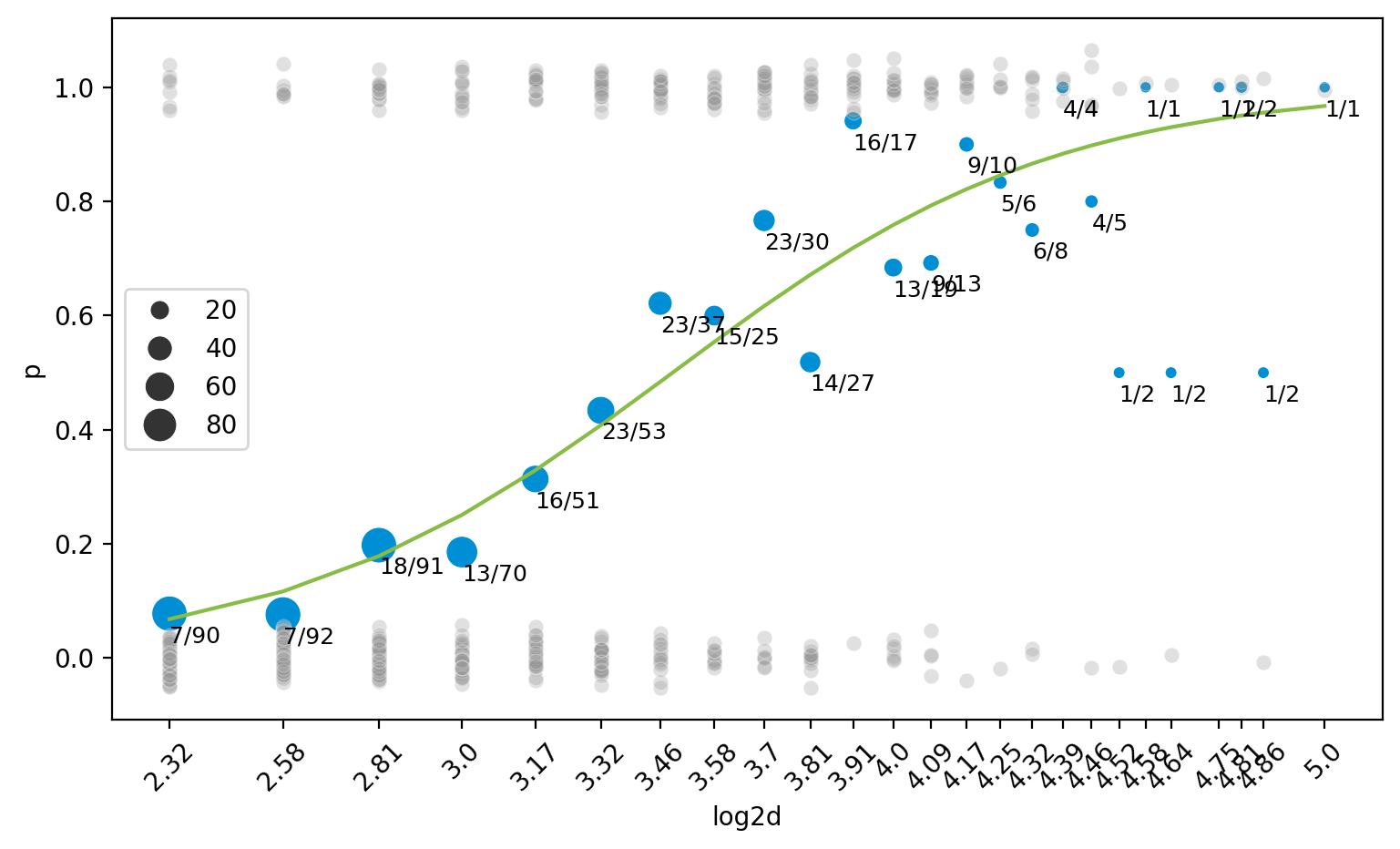
관측값들과 emperical probability 와 log odds 을 함께 살펴보면,
code
= plt.subplots(1 , 1 , figsize= (10 , 6 ))= blowbs_bn.log2d, y= blowbs_bn.p, size= blowbs_bn.m, c= "#008fd5" , sizes= (20 , 200 ), ax= ax)def jitter(values, j):return values + np.random.normal(0 , j, values.shape)= blowbs.log2d, y= jitter(blowbs.y, 0.02 ), alpha= .3 , c= ".6" , ax= ax)for i, row in blowbs_bn.iterrows():f" { row. died:n} / { row. m:n} " , xy= (row.log2d, row.p), xytext= (row.log2d, row.p- 0.05 ), size= 9 )round (2 ))= 'x' , rotation= 45 )"Emperical Probability" )
Logit 값(분홍색)을 추가해서 그리면,
code
= plt.subplots(1 , 1 , figsize= (10 , 6 ))= blowbs_bn.log2d, y= blowbs_bn.p, size= blowbs_bn.m, sizes= (20 , 200 ), c= "#008fd5" , ax= ax, legend= False )= blowbs_bn.log2d, y= blowbs_bn.log_odds, size= blowbs_bn.m, sizes= (20 , 200 ), color= "#f46a9b" , ax= ax)def jitter(values, j):return values + np.random.normal(0 , j, values.shape)= blowbs.log2d, y= jitter(blowbs.y, 0.02 ), alpha= .3 , c= ".6" , ax= ax)for i, row in blowbs_bn.iterrows():f"logit { row. died:n} / { row. m:n} " , xy= (row.log2d, row.log_odds), xytext= (row.log2d, row.log_odds- 0.4 ), size= 9 )round (2 ))= 'x' , rotation= 45 )"P & Logit" )"Emperical Probability and Logit" )# # polyfit 5 # x = np.linspace(blowbs_bn.log2d.min(), blowbs_bn.log2d.max(), 100) # y = np.polyval(np.polyfit(blowbs_bn.log2d, blowbs_bn.log_odds, 5), x) # sns.lineplot(x=x, y=y, ax=ax, color=".6") # # polyfit 1 # y = np.polyval(np.polyfit(blowbs_bn.log2d, blowbs_bn.log_odds, 1), x) # sns.lineplot(x=x, y=y, ax=ax, color=".6")
위의 logit값을 선형모형으로 예측하는 모형: \(\displaystyle \log\left(\frac{\hat{p}}{1-\hat{p}}\right) = b_0 + b_1 \cdot \log_{2} d\)
파라미터 \(b_0, b_1\) 의 추정은 잔차들의 제곱의 합을 최소로 하는 OLS 방식은 부적절하며, 대신에 Maximum Likelihood Estimation을 사용함.
아이디어는 관측치가 전체적으로 관찰될 likelihood가 최대가 되도록 \(b_0, b_1\) 을 선택하는 것임
이를 위해서 적절한 확률모형을 결합시켜야 함.
선택하는 확률 모형은 Bernoulli 분포임; 평균 \(E(Y|X) = p\) 이고, \(logit(E(Y|X)) = b_0 + b_1 \cdot \log_{2} d\)
Y를 1의 발생 빈도수로 변환해 Binomial distribution (이항분포)로 전개하는 방식도 있음; binomial logit model
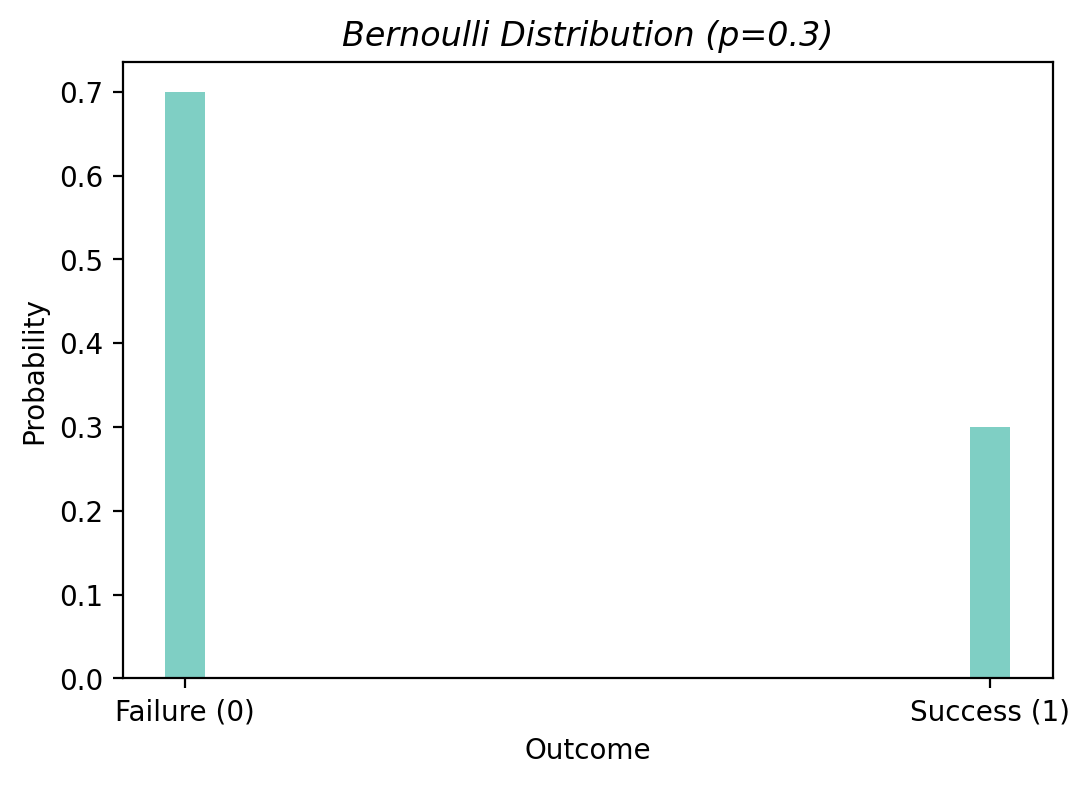
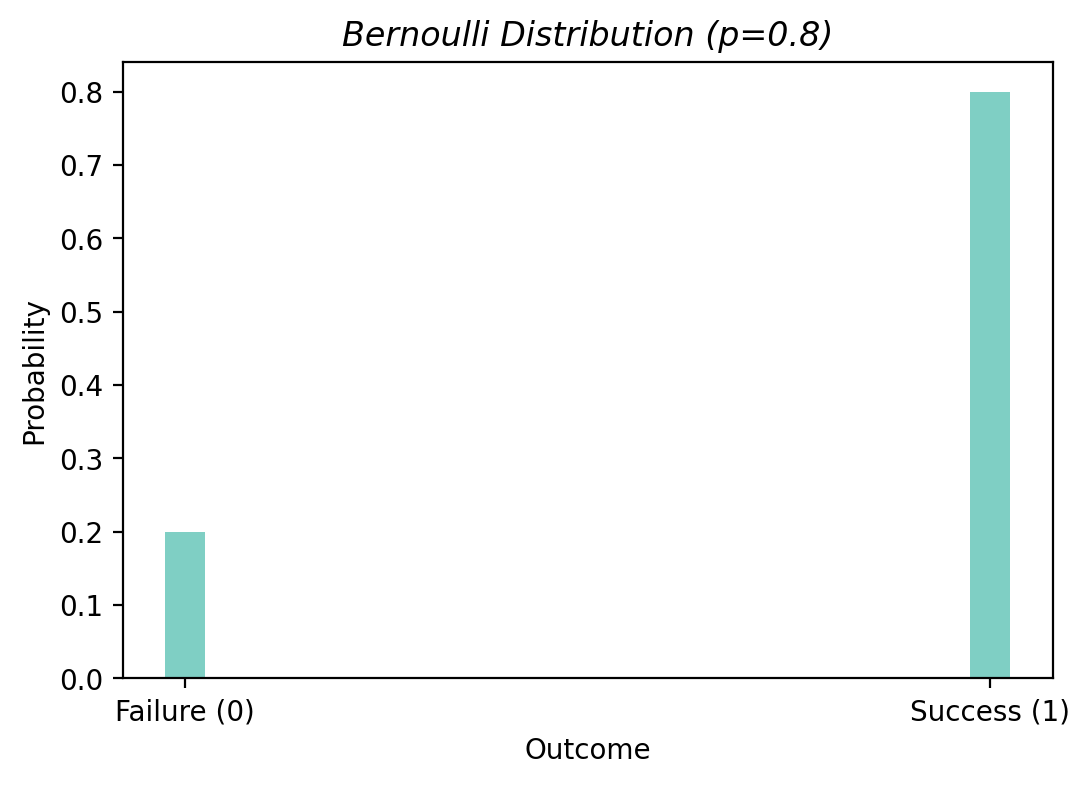
관찰값은 Bernoulli 분포로부터 발생했다고 가정 함으로써, 실제 관찰값들이 관찰될 확률/가능도를 기준으로 파라미터를 추정할 수 있음.
"log2d" )
         d    s  y           spp  log2d  label
2102  5.00 0.45  0  black spruce   2.32  alive
724   5.00 0.18  0  black spruce   2.32  alive
723   5.00 0.18  1  black spruce   2.32   died
...    ...  ... ..           ...    ...    ...
1784 29.00 0.38  1  black spruce   4.86   died
1079 29.00 0.25  0  black spruce   4.86  alive
3455 32.00 0.80  1  black spruce   5.00   died

[659 rows x 6 columns]
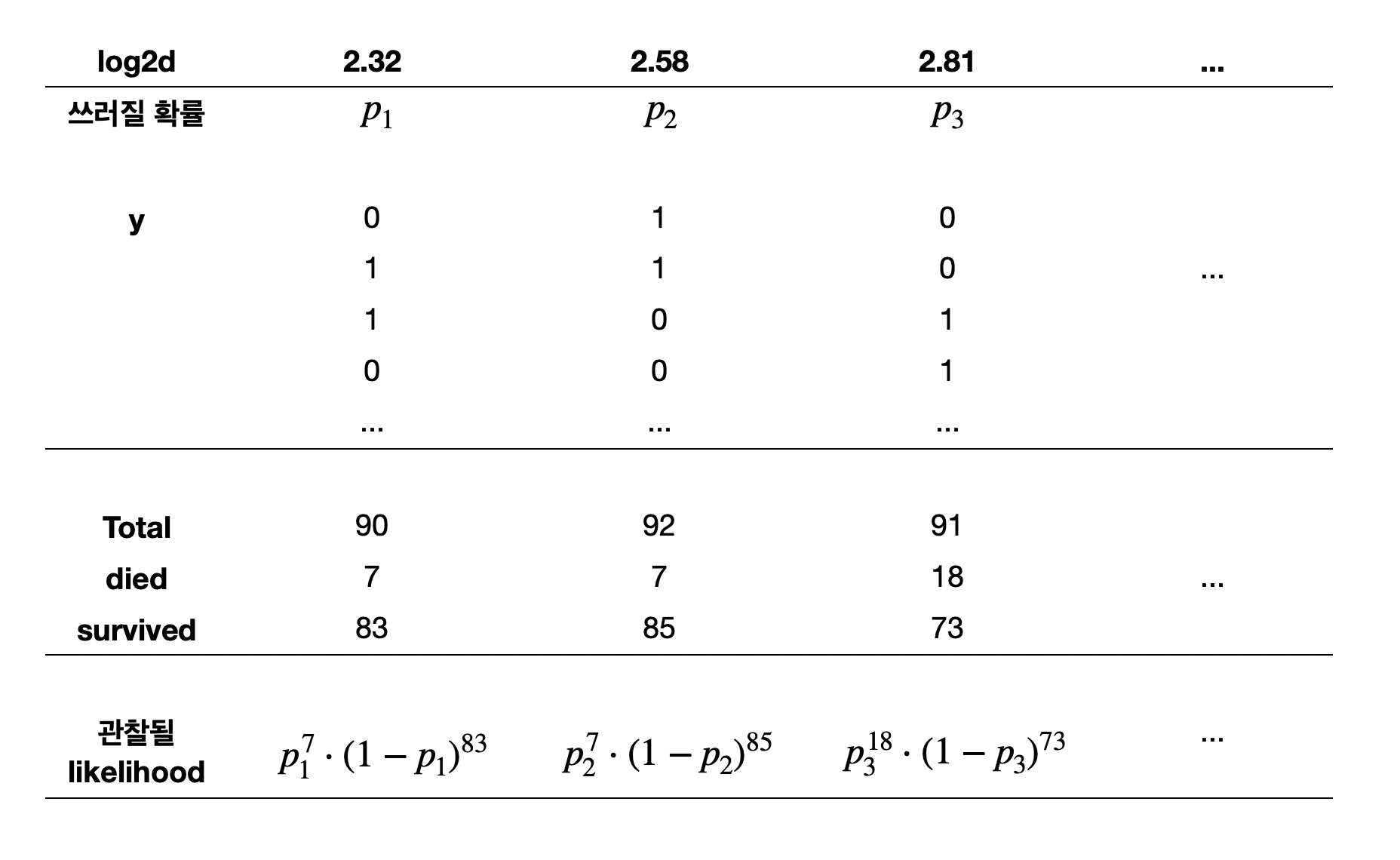
각 likelihood는 관측치들이 모두 독립 적으로 발생했다고 가정했을 때의 확률값이고,\(x_i\) (그에 대응하는 \(p_i\) )에 대해 관측치(\(y_i\) )가 관찰된 확률은 간결하게 다음과 같이 표현할 수 있음.
\[p_i^{y_i} (1-p_i)^{1-y_i}\]
\[\displaystyle \text{log likelihood}=\log \prod_{i=1}^{n}{P_i}=\sum_{i=1}^{n} y_i \cdot \log p_i + (1-y_i) \cdot \log(1-p_i)\]
모든 데이터가 관찰될 likelihood = \(p_1^7 (1-p_1)^{83} \cdot p_2^7 (1-p_2)^{85} \cdot p_3^{18} \cdot (1-p_3)^{73} \cdots\)
이 때, 모형을 예측변수 \(X\) 의 1차 다항함수로 fit한다면, \(\displaystyle \log\left(\frac{p_i}{1-p_i}\right) = \beta_0 + \beta_1 \cdot x_i\) 인데,\(\displaystyle p_i = \sigma(\beta_0 + \beta_1 x_i) = \frac{1}{1+e^{-(\beta_0 + \beta_1 \cdot x_i)}}\)
Likelihood = \(\displaystyle \left(\frac{1}{1+e^{-(\beta_0 + \beta_1 \cdot 2.32)}}\right)^7 \left(1 - \frac{1}{1+e^{-(\beta_0 + \beta_1 \cdot 2.32)}}\right)^{83} \cdot \left(\frac{1}{1+e^{-(\beta_0 + \beta_1 \cdot 2.58)}}\right)^7 \left(1 - \frac{1}{1+e^{-(\beta_0 + \beta_1 \cdot 2.58)}}\right)^{85} \cdots\)
이 Likelihood가 최대가 되도록 \(\beta_0, \beta_1\) 의 추정치를 찾음.
위의 Log likelihood = \(\displaystyle \sum_{i=1}^{n} y_i \cdot \log p_i + (1-y_i) \cdot \log(1-p_i)\) 는
머신러닝에서 손실함수로 사용되는 cross-entropy loss와 (거의) 동일함.
\(L = -\frac{1}{n} \sum_{i=1}^{n} y_i \cdot \log p_i + (1-y_i) \cdot \log (1-p_i)\)
= [cross-entropy]: \(H(\tilde{q}, p)\) : [실제값(y)를 \(p\) 의 분포로 잘못 모델링했을 때의 평균 정보량]
= [부정확하게 예측되어 발생하는 정보 손실량: Kullback-Leibler divergence] + [경험분포 자체의 평균 정보량]
= \(KL(\tilde{q} | p) + H(\tilde{q})\)
관측 데이터로부터 경험분포 \(\tilde{q}\) 와, 모델이 만드는 모델분포 \(p\) 를 구분
경험분포 \(\tilde{q}\) : 여기서는 degenerate Bernoulli 분포
\(y_i\) (관측값)\(1 - y_i\)
모델분포 \(p\)
\(\hat{p}_i\) (예측값)\(1 - \hat{p}_i\)
정보량: \(-\log p\)
엔트로피 \(H\) : 평균 정보량(정보의 기대값) \(\displaystyle \sum p \cdot (-\log p) = \sum -p \cdot \log p\)
By Claude Sonnet 4.6
오늘 길에서 만나는 사람들의 키를 예측한다고 했을 때, 키가 180cm가 넘는 여자를 만나는 사건의 정보:
상황 설정
오늘 서울 길거리를 걷습니다. 마주치는 사람들의 키는 서울 여성의 실제 분포 \(p\) 를 따릅니다. 이 \(p\) 는 내가 어떻게 생각하든 상관없이 세상에 고정되어 있는 실제 빈도입니다.
사건 — 가능성이 하나로 확정되는 순간
걷기 전에는 “165cm일 수도 있고, 170cm일 수도 있고, 2m가 넘을 수도 있다”는 가능성들이 열려 있습니다. 누군가를 마주치는 순간, 그 가능성들 중 하나가 실현됩니다. “키 180cm 이상 여성을 만났다”는 그 실현된 하나의 사건입니다.
정보량 — 실현된 사건이 얼마나 드문가/놀라운가
\[I(\text{180cm 이상}) = -\log_2 p(\text{180cm 이상}) = -\log_2 (0.001) \approx 10 \text{ bits}\]
여기서 \(p\) 는 서울에서 실제로 180cm 이상 여성이 얼마나 드문가입니다. 이 사건이 실제 세계에서 0.1%밖에 일어나지 않는다는 사실 자체가 정보량을 결정합니다.
엔트로피 — 걷기 전, 실제 세계의 불확실성
\[H(p) = \sum_x p(x) \cdot (-\log_2 p(x))\]
집을 나서기 전 상태입니다. 오늘 어떤 키의 사람을 만날지 모릅니다. 이 불확실성의 총량이 엔트로피입니다.
엔트로피는 정보량의 가중평균입니다. 자주 만나는 사람(높은 \(p\) , 낮은 정보량)과 드물게 만나는 사람(낮은 \(p\) , 높은 정보량)을 모두 고려해서 평균 낸 것입니다.
세 개념의 시점과 역할
사건
마주친 순간
가능성 중 하나가 실현됨
정보량 \(I(x)\)
마주친 후
이 사건이 실제로 얼마나 드문가/놀라운가
엔트로피 \(H(p)\)
걷기 전
실제 세계의 평균 불확실성
앞서 Ridge, Lasso에서와 비슷한 원리로 OLS가 아닌 ML(maximum likelihood) estimator에 penalty를 적용하는 방식임.
에를 들어, Logistic regression with L2 regularization: 다음 손실함수를 최소화하도록 파라미터를 추정
\(\displaystyle L = \frac{1}{n} \left[ - \sum_{i=1}^{n} \left(y_i \cdot \log p_i + (1-y_i) \cdot \log(1-p_i)\right) + \frac{\lambda}{2} \sum_{j=1}^{p} \beta_j^2 \right]\)
import statsmodels.formula.api as smf= smf.logit('y ~ log2d' , data= blowbs).fit()print (mod.summary())
Optimization terminated successfully.
         Current function value: 0.499165
         Iterations 6
                           Logit Regression Results
==============================================================================
Dep. Variable:                      y   No. Observations:                  659
Model:                          Logit   Df Residuals:                      657
Method:                           MLE   Df Model:                            1
Date:                Tue, 27 May 2025   Pseudo R-squ.:                  0.2316
Time:                        23:59:25   Log-Likelihood:                -328.95
converged:                       True   LL-Null:                       -428.10
Covariance Type:            nonrobust   LLR p-value:                 4.888e-45
==============================================================================
                 coef    std err          z      P>|z|      [0.025      0.975]
------------------------------------------------------------------------------
Intercept     -7.8162      0.628    -12.437      0.000      -9.048      -6.584
log2d          2.2408      0.190     11.773      0.000       1.868       2.614
==============================================================================
Scikit-learn의 LogisticRegression()은 디폴트로 \(l2\) regularization을 사용함: 참고 문서
우선, train-test split을 통해 데이터를 나눈 후, LogisticRegression()을 적용하면,
from sklearn.model_selection import train_test_splitfrom sklearn.linear_model import LogisticRegression= blowbs[['log2d' ]]= blowbs['y' ]= train_test_split(X, y, test_size= 0.5 , random_state= 0 )= LogisticRegression(penalty= None ) # l1, l2 regularization 가능 print (lr.coef_, lr.intercept_)# [[2.08]] [-7.26] # As a DataFrame with column names = pd.DataFrame({"coef" : lr.coef_[0 ], "name" : X.columns})# coef name # 0 2.08 log2d
위 fitted model의 예측값들
code
= plt.subplots(1 , 1 , figsize= (9 , 5 ))= blowbs_bn.log2d, y= blowbs_bn.p, size= blowbs_bn.m, c= "#008fd5" , sizes= (20 , 200 ), ax= ax)def jitter(values, j):return values + np.random.normal(0 , j, values.shape)= blowbs.log2d, y= jitter(blowbs.y, 0.02 ), alpha= .3 , c= ".6" , ax= ax)for i, row in blowbs_bn.iterrows():f" { row. died:n} / { row. m:n} " , xy= (row.log2d, row.p), xytext= (row.log2d, row.p- 0.05 ), size= 9 )round (2 ))# x-axis with 45 degree rotation = 'x' , rotation= 45 )# fitted line = blowbs.log2d, y= mod.predict(blowbs["log2d" ]), ax= ax, color= "#87bc45" )
Predictive Accuracy
모형의 예측 정확성
분류 문제의 경우, 보통 두 단계를 거쳐 예측
Inference: 클래스에 속할 확률을 추정; 확률을 추정하지 않는 알고리즘도 있음.
Decision: 추정된 확률을 기반으로 클래스를 결정
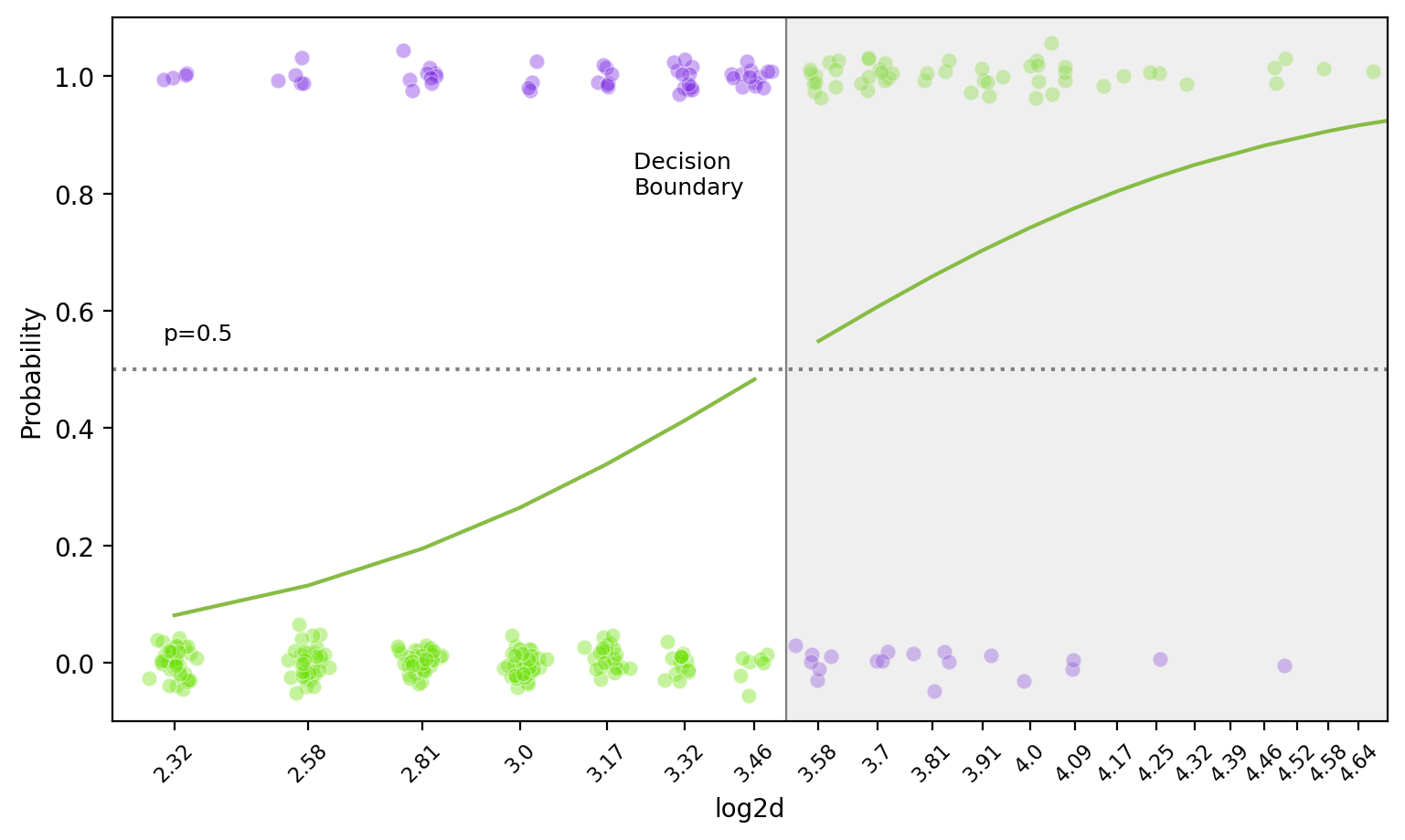
기본적으로 0.5 이상이면 1로, 그렇지 않으면 0으로 분류
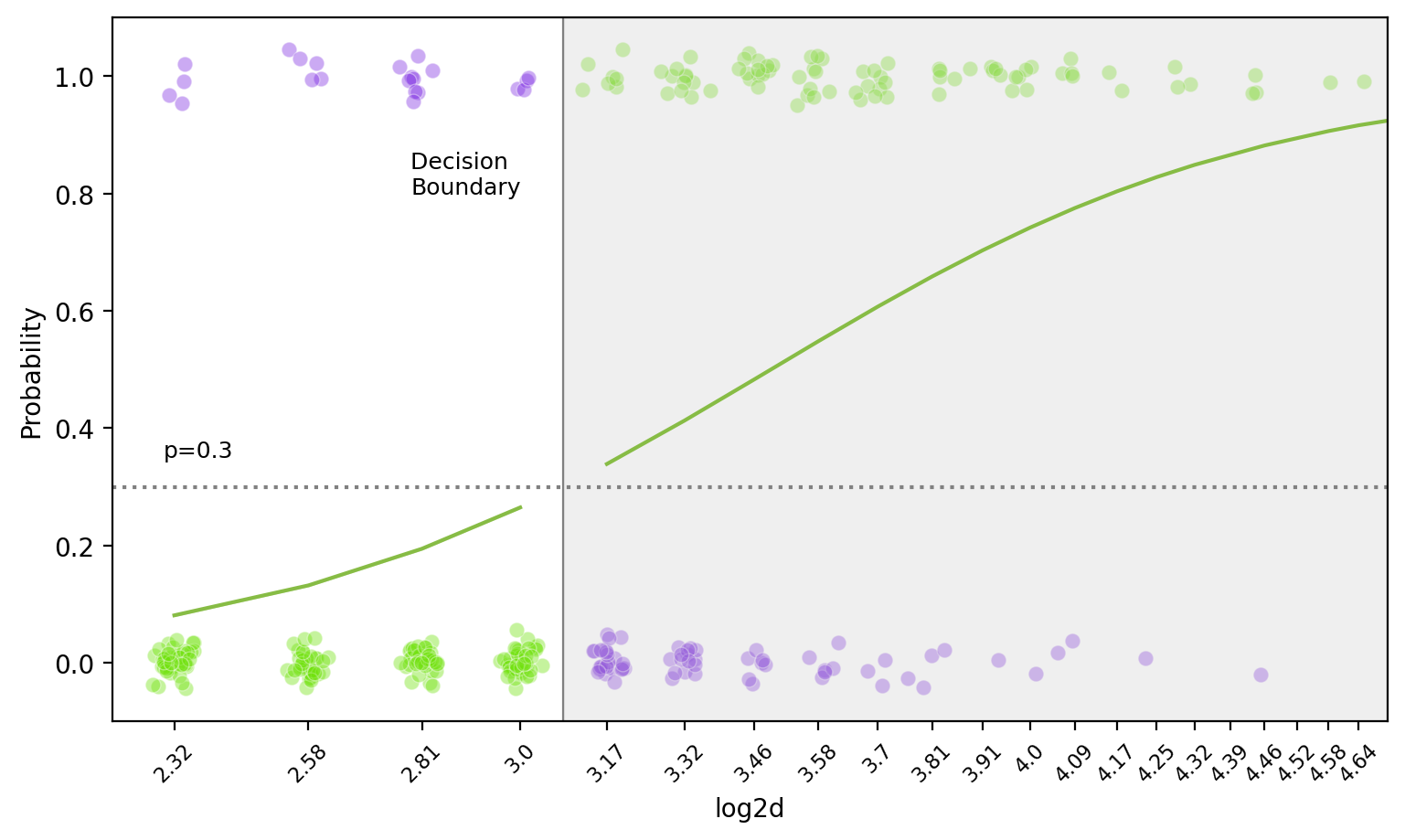
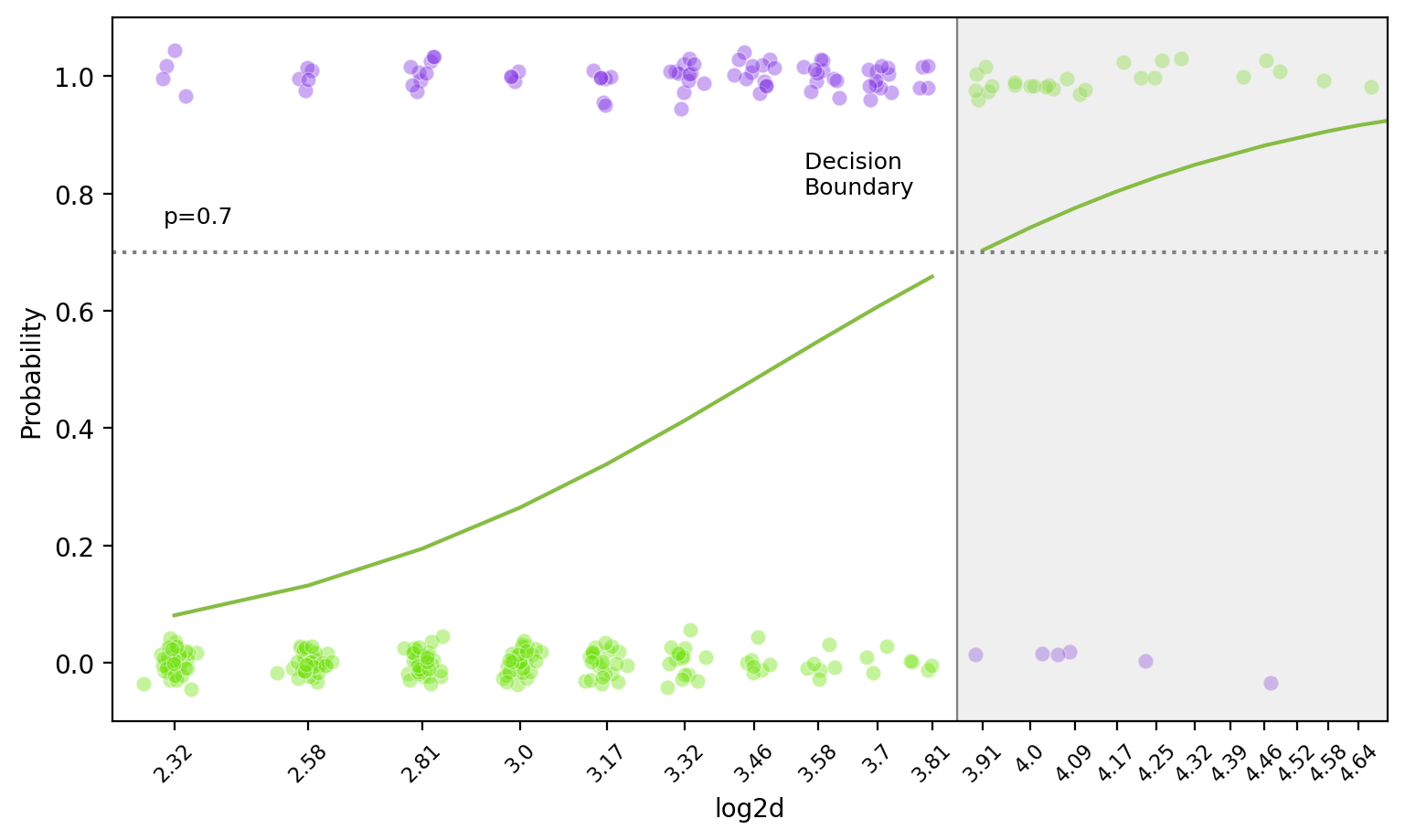
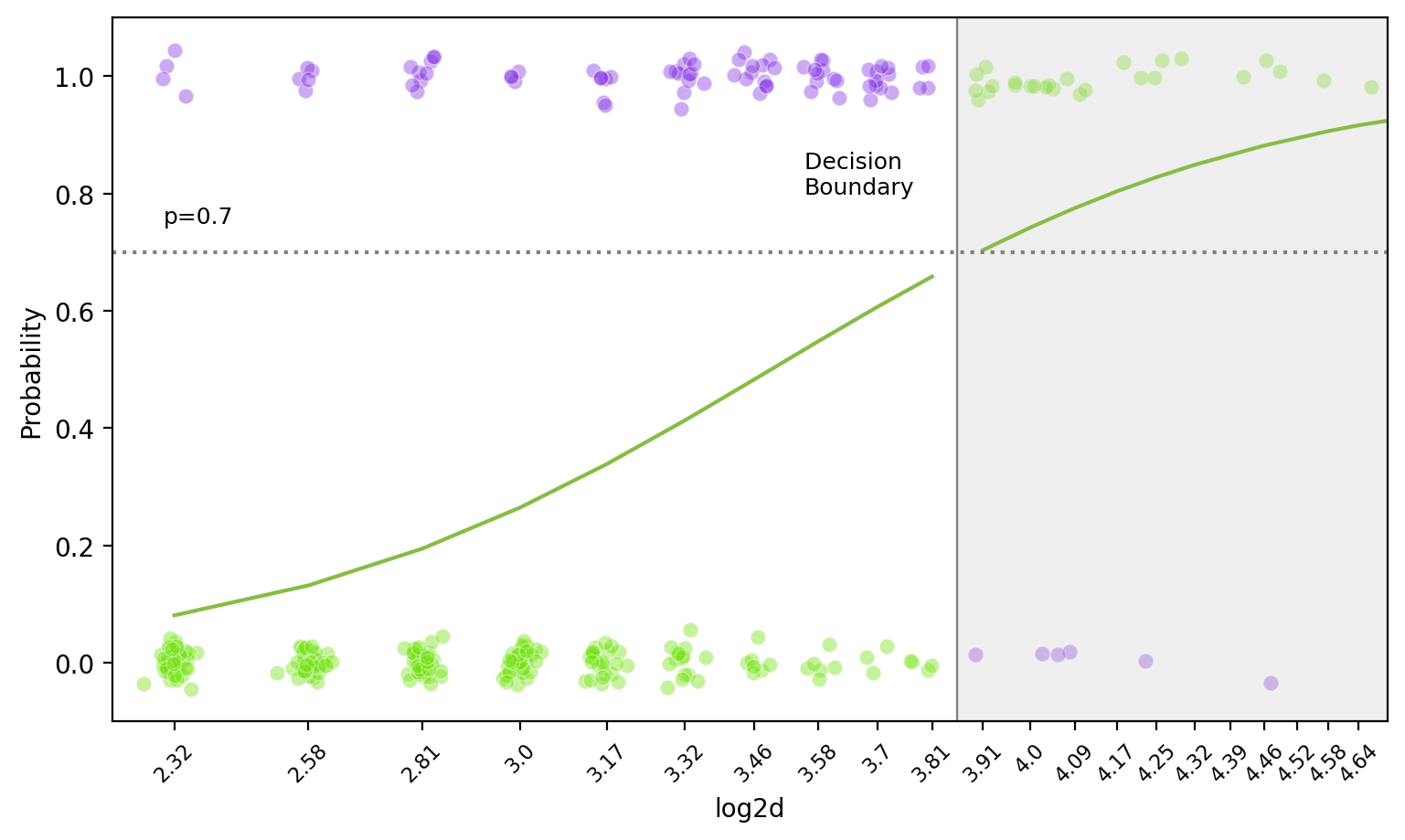
Threshold를 조정해 분류를 조정할 수 있음
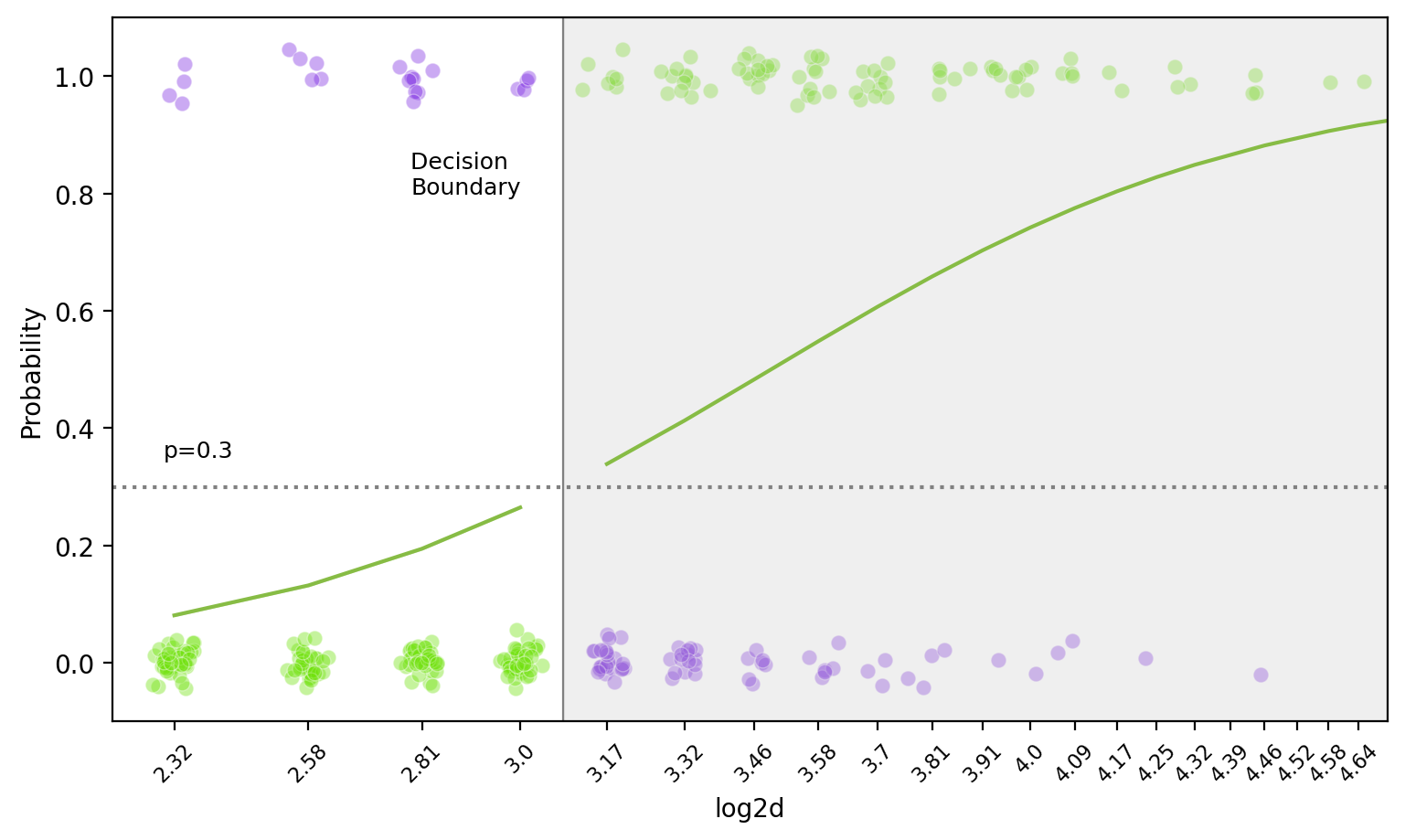
예를 들어, 확실한 경우(p > 0.8 )에만 1로 분류
애매한 확률 구간의 경우 결정을 유보할 수 있음; reject option
이 때, 모형의 예측 정확성을 평가하는 두 가지 방식이 있음.
확률 대한 예측 정확성 (evaluating predicted probability)
클래스에 대한 예측 정확성 (evaluating predicted class)
Evaluation of predicted probability
이제 이 모형이 좋은 모형인지 살펴보기 위해 residual, 잔차를 살펴볼 수 있는가?
Pearson residual: \(\displaystyle \frac{y_i - \hat{p}_i}{\sqrt{\hat{p}_i (1-\hat{p}_i)}}\)
Deviance residual: \(\displaystyle sign(y_i - \hat{p}_i) \sqrt{-2[y_i \log\hat{p}_i + (1-y_i) \log(1-\hat{p}_i)]}\)
Deviance를 이용해 OLS에서의 \(R^2\) 와 비슷한 개념을 구성: Pseudo R-squared
Model deviance, \(D = -2[\log likelihood - \log likelihood_{\text{perfect}})]\)
Perfect model의 likelihood: 1
Null deviance: 절편만 있는 모형의 deviance; 856.2073760911842
Pseudo R-squared: \(\displaystyle \frac{Null~Deviance - Deviance}{Null~Deviance}\)
Cox-Snell’s Pseudo R-squared
Nagelkerke’s Pseudo R-squared
“Coefficient of discrimination” (Tjur, 2009): average \(\hat{p}\) when \(y=1\) - average \(\hat{p}\) when \(y=0\)
클래스별 예측 확률의 분포/히스토그램
code
"y2" ] = test_pred["y" ].map ({0 : "survived (y=0)" , 1 : "died (y=1)" })= 'pred_prob' )= "#ef9b20" ), so.Hist(bins= 12 ))"y2" )= "Predicted Probability" , y= "Count" )= (7 , 4 ))
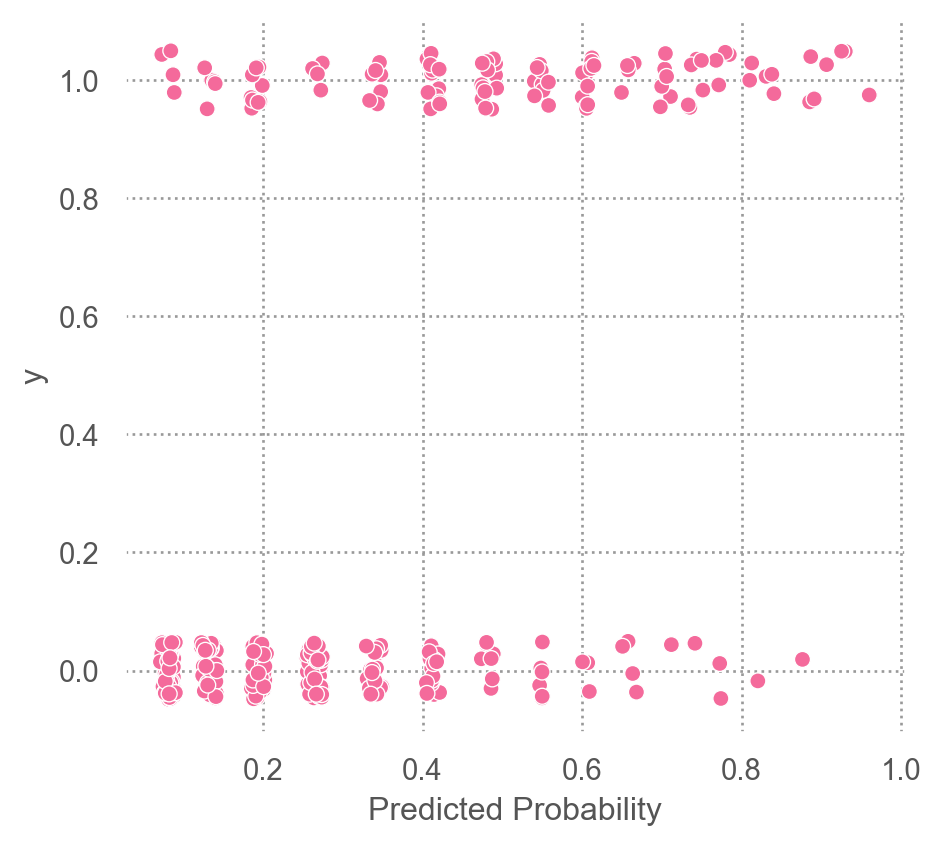
각 (확률 값의) bin에 포함되는 관측치의 실제 값(\(y \in \{0, 1\}\) )의 비율을 계산해 시각화
code
from sklearn.calibration import calibration_curve# 3. calibration_curve로 실제 비율 계산 = calibration_curve("y" ], test_pred["pred_prob" ], n_bins= 10 , strategy= "uniform" = prob_pred, y= prob_true)= "o" , color= "#f46a9b" ))= ".3" , linestyle= ":" ), y= prob_pred)= so.Continuous().tick(at= np.linspace(0 , 1 , 11 )))= "(10-Binned) Predicted Probability" ,= "Observed Event Percentage \n (Emperical Probability)" ,= "Calibration Plot" ,= (5 , 4.5 ))
Evaluation of predicted class
예측된 확률을 기반으로 binary outcome/class으로 예측하여, 모형의 예측력을 평가
예측된 확률값에 대해 임계치를 정하여, 예를 들어 0.5보다 크면 1, 0.5보다 작으면 0으로 분류하여, 이 binary 예측값과 실제값을 비교하여, 예측력을 평가
Confusion matrix
ROC curve
Threshold: 0.5인 경우, accuracy rate: 0.78
survied(0)
died(1)
survied(0)
203
54
died(1)
19
54
survied(0)
died(1)
survied(0)
True Negative
False Positive
died(1)
False Negative
True Positive
다른 threshold를 적용하면,
Threshold: 0.1인 경우,
survied(0)
died(1)
survied(0)
42
4
died(1)
180
104
Accuracy rate: 0.44
Threshold: 0.9인 경우
survied(0)
died(1)
survied(0)
222
104
died(1)
0
4
Accuracy rate: 0.68
code
from sklearn.metrics import accuracy_scorefrom ISLP import confusion_table# cutoff = 0.5 = confusion_table(test_pred["pred_class" ], test_pred["y" ])= accuracy_score(test_pred["y" ], test_pred["pred_class" ])print (f"Accuracy rate: { score:.2f} " )# cutoff = 0.1 = confusion_table(test_pred["pred_prob" ] > 0.1 , test_pred["y" ])= accuracy_score(test_pred["y" ], test_pred["pred_prob" ] > 0.1 )print (f"Accuracy rate: { score:.2f} " )# cutoff = 0.9 = confusion_table(test_pred["pred_prob" ] > 0.9 , test_pred["y" ])= accuracy_score(test_pred["y" ], test_pred["pred_prob" ] > 0.9 )print (f"Accuracy rate: { score:.2f} " )
분류모형의 성능을 평가하기 위한 여러 지표들
Precision & Recall
Precision (정밀도): \(\hat{y}=1\) 일 때, \(y=1\) 일 확률
정보검색에서 반환된 문서들 중 실제로 관련 있는 문서의 비율
높은 precision은 사용자가 검색 결과에서 불필요한 정보를 적게 얻고, 대부분 유용한 정보를 얻는다는 것을 의미
하지만, 관련은 있지만 놓친 정보는 많을 수 있음.
검색 결과의 정확도를 평가
시스템이 스팸으로 분류한 이메일 중 실제 스팸인 이메일의 비율
높은 precision은 스팸으로 잘못 분류된 정상 이메일이 적다는 것을 의미
하지만, 스팸 이메일이 정상 이메일함에 나타날 수 있음.
검사를 통해 암으로 진단받은 사람이 실제로 암을 가지고 있을 확률
높은 precision은 암 진단을 받은 사람에게 잘못된 암 진단을 내리지 않는 것을 의미
Recall (재현율): \(y=1\) 일 때, \(\hat{y}=1\) 일 확률
정보검색에서 관련 문서들 중에서 실제로 시스템이 반환한 문서의 비율
높은 recall은 사용자가 찾고자 하는 모든 관련 정보를 검색 결과에서 얻을 수 있다는 것을 의미
하지만, 관련 없는 정보도 많이 포함될 수 있음.
검색 시스템의 탐색 능력을 평가
실제 스팸 이메일 중에서 시스템이 스팸으로 올바르게 분류한 비율
높은 recall은 대부분의 스팸 이메일이 정확히 스팸으로 분류된다는 것을 의미
하지만, 정상 이메일이 스팸함으로 분류될 수 있음.
실제로 암을 가진 사람 중에서 검사를 통해 암으로 진단받은 사람의 비율
높은 recall은 암 환자를 놓치지 않고 모두 찾아낸다는 것을 의미
참 양성, true positive rate (TPR), 또는 sensitivity라고도 함
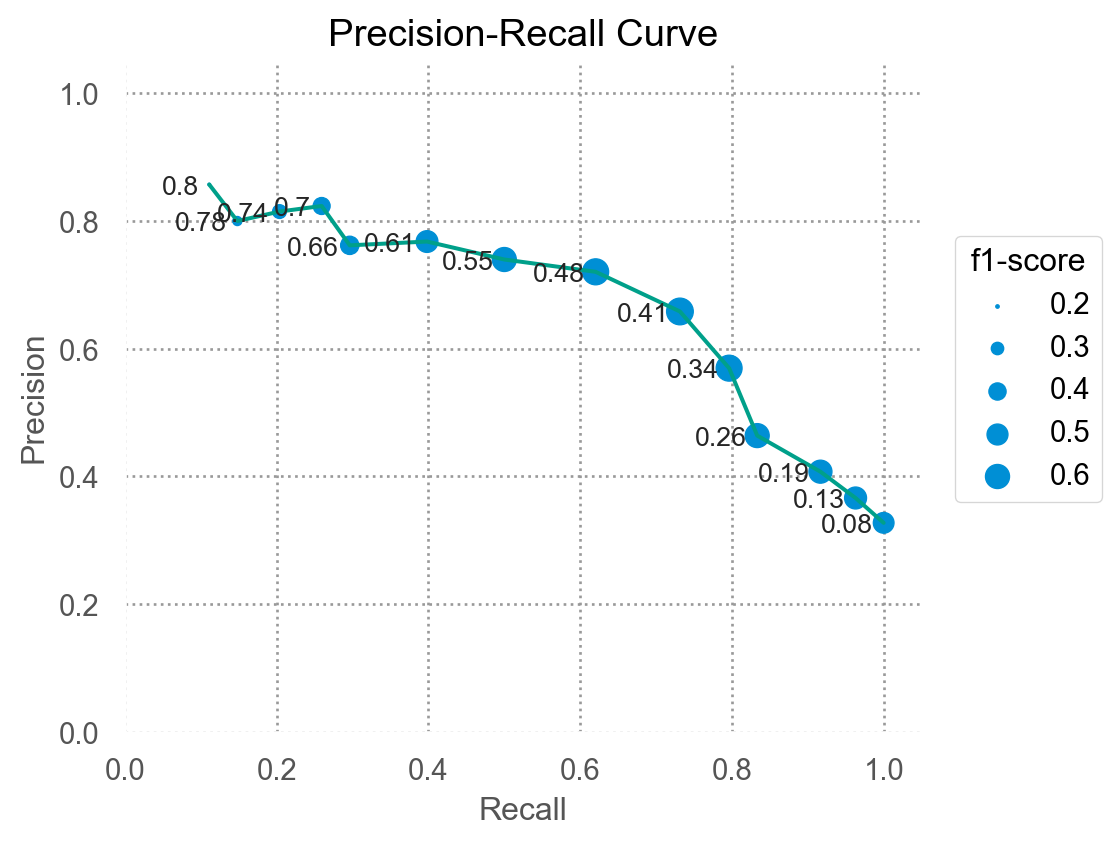
precision & recall trade-off : 이 둘 사이에는 종종 상충 관계가 있음. Precision을 높이기 위해 예측 확률에 대한 더 엄격한 기준을 사용하면 recall이 낮아질 수 있고, 반대로 recall을 높이기 위해 더 느슨한 기준을 사용하면 precision이 낮아질 수 있음.
정보 검색의 맥락: precision을 높여 사용자가 불필요한 정보를 받지 않게 해주며, recall을 높여 필요한 정보를 놓치지 않도록 함.
스팸 필터링의 맥락: precision을 높여 자주 스팸 메일함을 확인하지 않아도 되도록 하며, recall을 높여 대부분의 스팸 이메일이 차단되어 정상 메일함에서 보이지 않도록 쾌적한 환경을 제공할 수 있음.
Sensitivity & specificity
한편, 이상치 탐지라든가 희귀 질병 진단 등 클래스 불균형 데이터셋에서는 precision & recall이 더 유용할 수 있음.
Sensitivity (민감도): \(y=1\) 일 때, \(\hat{y}=1\) 일 확률
True positive rate (TPR) (= Recall)
높은 민감도는 질병이 있는 사람을 놓치지 않고 모두 찾아내는 것(참 양성)을 의미
Specificity (특이도): \(y=0\) 일 때, \(\hat{y}=0\) 일 확률
True negative rate (TNR)
실제로 질병이 없는 사람을 얼마나 잘 (질병이 없다고) 식별하는지(참 음성)를 나타냄
Specific의 의미는 초점이 되는 특정(specific) 질병에만 반응하는 진단 툴이기를 바란다는 의미임. 가령, 폐렴이 아닌데(아마도 다른 병일 수 있는데) 폐렴이라고 진단하지 않기를 기대함.
높은 특이도는 (특정) 질병이 없는 사람에게 그 질병이 있다고 잘못 진단하지 않는 것을 의미함
단, 희귀 질병을 진단하는 경우, 정상인(negative)을 올바로 식별하는 것은 매우 쉽기 때문에 질병이 없는 사람에 대한 판별력이 과대추정될 수 있음; precision이 더 유용할 수 있음.
1 - FPR (False Positive Rate; false alarm)
0, 1을 바꿨을 때의 즉, 0을 (양성)기준으로 했을 때의 recall 값이 됨.
특이도가 높은 테스트라면 질병이 없다는 판정은 신뢰할 만함. 즉, 0(음성)을 기준으로한 sensitivity가 높은 것이 됨.
거짓 음성 비율: False negative rate (FNR); \(y=1\) 일 때, \(\hat{y}=0\) 일 확률: 1 - sensitivity
거짓 양성 비율: False positive rate (FPR) 또는 False alarm; \(y=0\) 일 때, \(\hat{y}=1\) 일 확률: 1 - specificity
위의 confusion matrix로부터 지표들을 계산하면,
Threshold: 0.1인 경우,
survied(0)
died(1)
survied(0)
42
4
died(1)
180
104
Threshold: 0.9인 경우
survied(0)
died(1)
survied(0)
222
104
died(1)
0
4
recall = 104 / (4 + 104) = 0.96
precision = 104 / (180 + 104) = 0.37
specificity = 42 / (42 + 180) = 0.19
accuracy = (42 + 104) / (42 + 4 + 180 + 104) = 0.44
recall = 4 / (4 + 104) = 0.04
precision = 4 / (0 + 4) = 1.00
specificity = 222 / (222 + 0) = 1.00
accuracy = (222 + 4) / (222 + 104 + 0 + 4) = 0.68
Receiver operating characteristic (ROC) curve
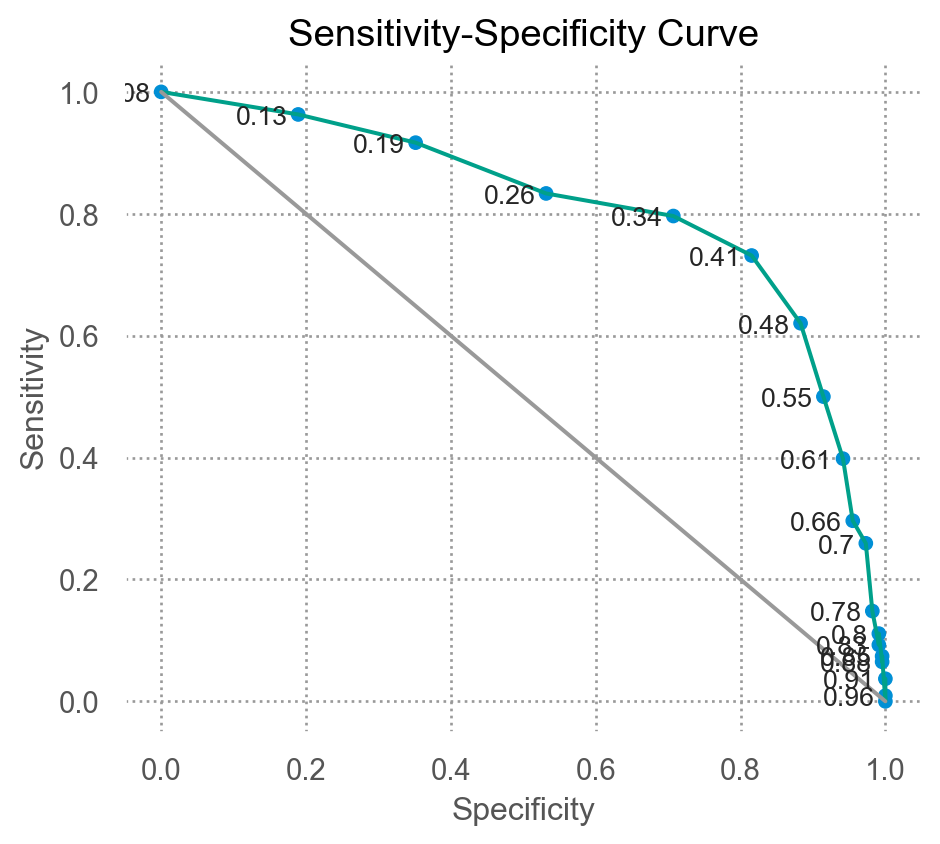
예측된 확률에 대한 임계치를 조정함에 따라 옳은 예측과 틀린 예측의 비율이 어떻게 달라지는지 살펴봄으로써 임계치를 설정하는데 도움을 줌
잘못된 예측에 대한 비용이 다르다면, 특정 임계치를 선택하는 것을 고려해야 함
code
from sklearn.metrics import roc_curve= roc_curve(test_pred.y, test_pred.pred_prob)= pd.DataFrame("thresholds" : thresholds.round (2 ),"False Pos" : fpr,"sensitivity(TPR)" : tpr,"specificity(TNR)" : 1 - fpr"thresholds" ).head(10 )## ROC curve # 위에서 얻은 roc 데이터을 사용하여 그리거나 # RocCurveDisplay를 이용 from sklearn.metrics import RocCurveDisplay= RocCurveDisplay(fpr= fpr, tpr= tpr).plot()# scikit-learn의 visualization 문서 참조 # https://scikit-learn.org/stable/visualizations.html
code
from sklearn.metrics import precision_recall_curve= precision_recall_curve(test_pred.y, = pd.DataFrame("thresholds" : np.append(thresholds.round (2 ), 1 ),"precision" : precision,"recall" : recall,"f1-score" : 2 * precision * recall / (precision + recall)"recall > 0.1" )"thresholds" ).head(10 )# precision-recall curve # 위에서 얻은 pr 데이터을 사용하여 그리거나 # PrecisionRecallDisplay를 이용 from sklearn.metrics import PrecisionRecallDisplay= PrecisionRecallDisplay(precision= precision, recall= recall).plot()# scikit-learn의 visualization 문서 참조 # https://scikit-learn.org/stable/visualizations.html
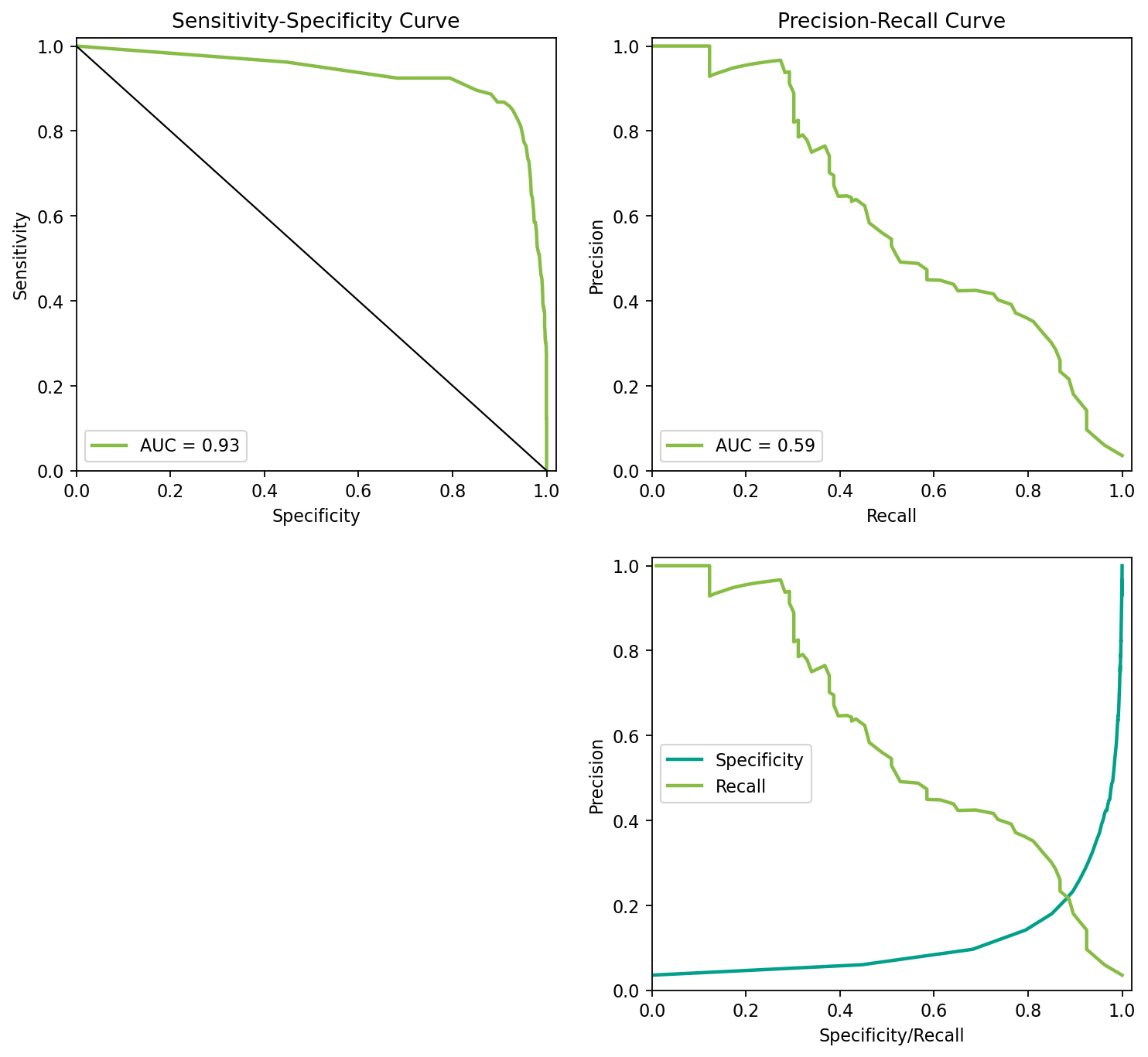
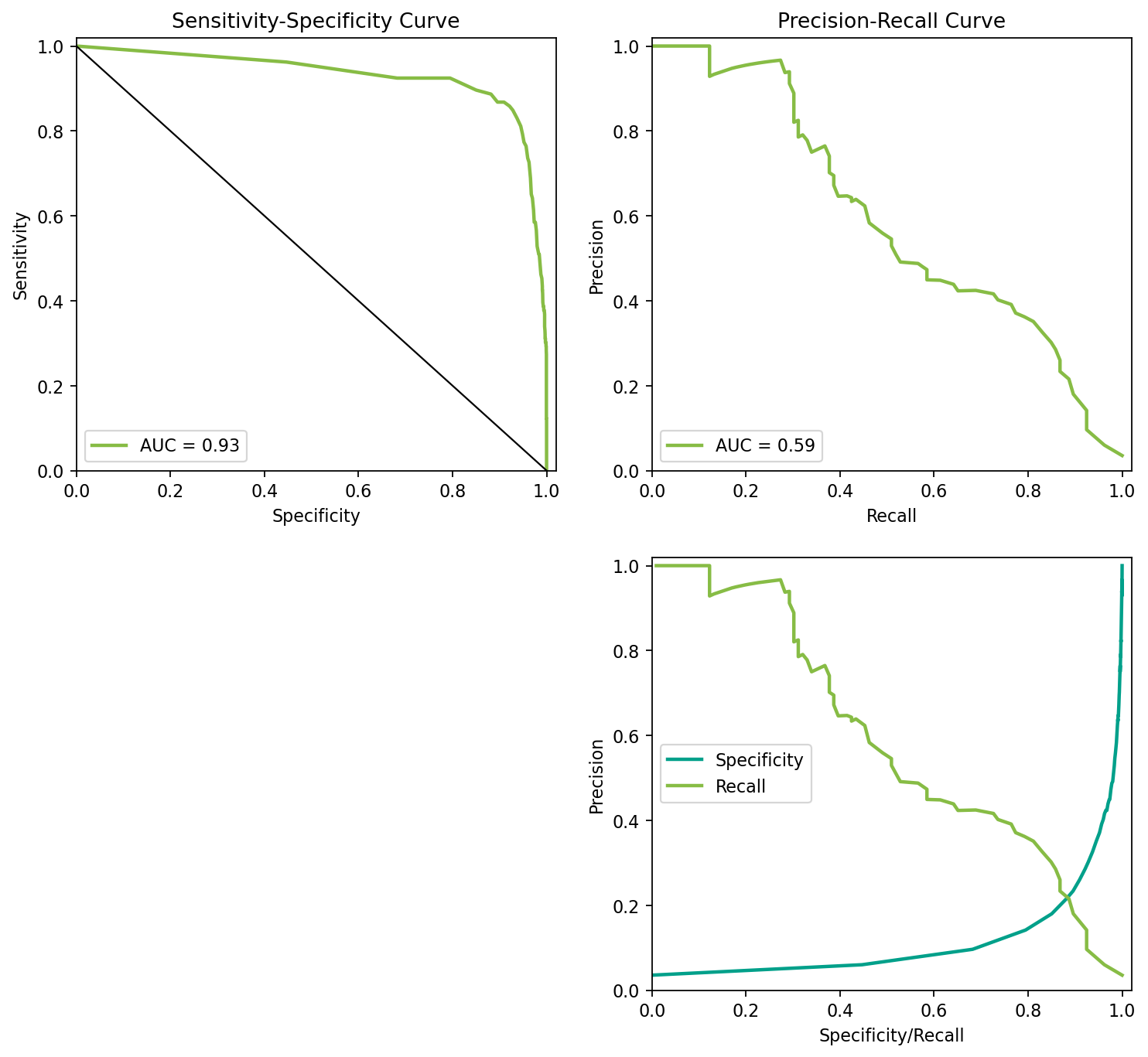
위에서 언급한 클래스 불균형의 예들: 이상치 탐지, 희귀 질병 진단 등에서는 precision & recall이 더 유용할 수 있음.
code
from sklearn.datasets import make_classificationfrom sklearn.model_selection import train_test_splitfrom sklearn.ensemble import RandomForestClassifierfrom sklearn.linear_model import LogisticRegressionfrom sklearn.metrics import roc_curve, auc, precision_recall_curve, average_precision_score# Create an imbalanced dataset = make_classification(n_samples= 10000 , n_features= 20 , n_classes= 2 ,= [0.97 , 0.03 ], random_state= 42 )# Split the dataset into training and testing sets = train_test_split(X, y, test_size= 0.3 , random_state= 42 )# Train a random forest classifier = RandomForestClassifier(n_estimators= 100 , random_state= 42 )# Get the probability scores for the testing set = clf.predict_proba(X_test)[:, 1 ]## 혹은 logistic regression # lr = LogisticRegression() # y_score = lr.predict_proba(X_test)[:, 1] # Calculate the ROC curve = roc_curve(y_test, y_score)= 1 - fpr= auc(fpr, tpr)# Calculate the Precision-Recall curve = precision_recall_curve(y_test, y_score)= average_precision_score(y_test, y_score)# Plot the ROC curve = (11 , 10 ), dpi= 80 )2 ,2 ,1 )= '#87bc45' , lw= 2 , label= 'AUC = %0.2f ' % roc_auc)1 , 0 ], [0 , 1 ], color= 'k' , lw= 1 , linestyle= '-' )0.0 , 1.02 ])0.0 , 1.02 ])'Specificity' )'Sensitivity' )'Sensitivity-Specificity Curve' )= "lower left" )# Plot the Precision-Recall curve 2 ,2 ,2 )= '#87bc45' , lw= 2 , label= 'AUC = %0.2f ' % pr_auc)0.0 , 1.02 ])0.0 , 1.02 ])'Recall' )'Precision' )'Precision-Recall Curve' )= "lower left" )= pd.DataFrame({"fpr" : fpr, "tpr" : tpr, "spc" : spc, "th" : th})= pd.DataFrame({"precision" : precision, "recall" : recall, "th" : np.append(th2, 1 )})= df1.merge(df2)2 ,2 ,4 )"spc" ], df_merge["precision" ], color= '#00A08A' , lw= 2 )"recall" ], df_merge["precision" ], color= '#87bc45' , lw= 2 )0.0 , 1.02 ])0.0 , 1.02 ])'Precision' )'Specificity/Recall' )"Specificity" , "Recall" ])
Classifier의 전체적 성능에 대한 지표
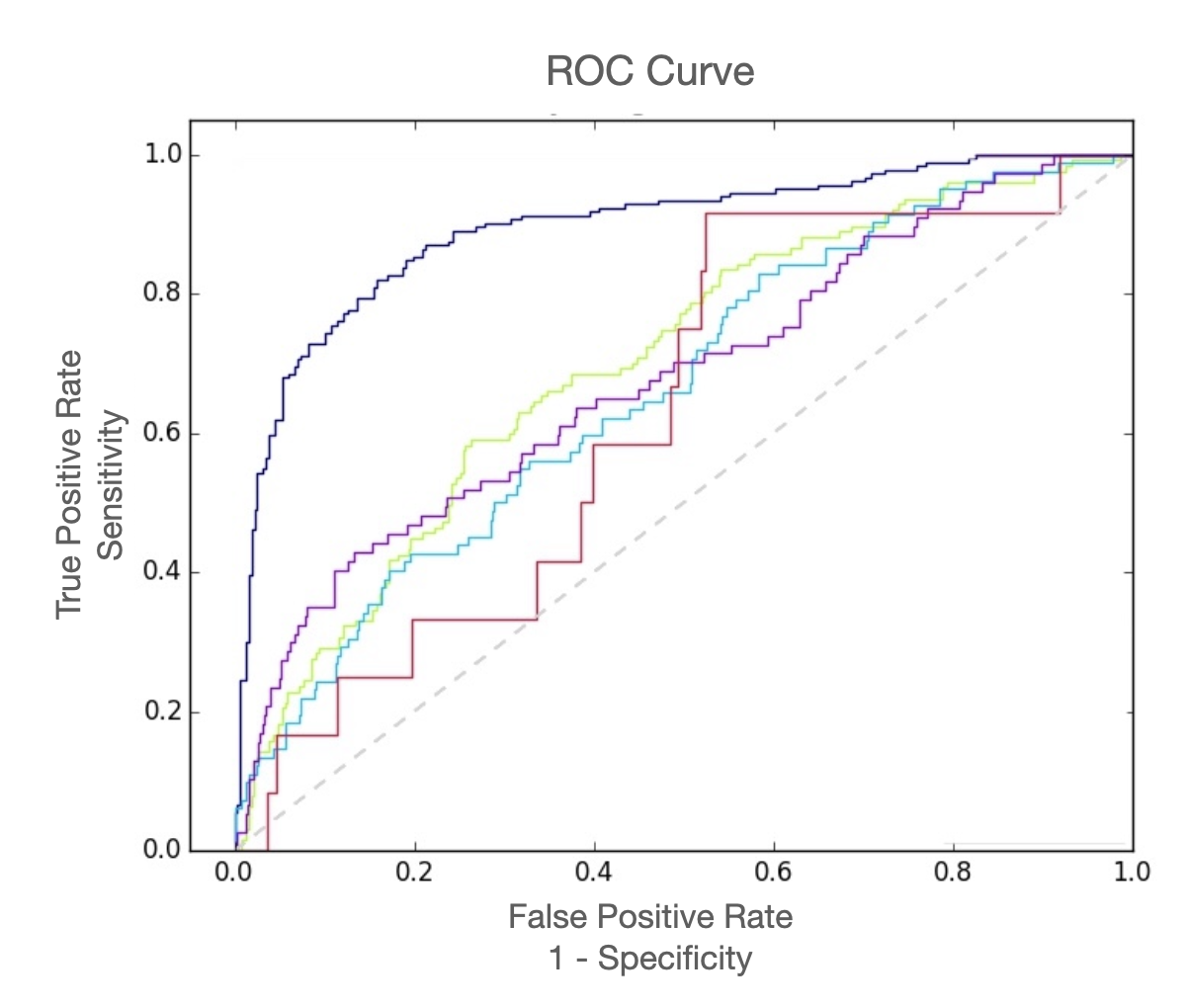
ROC curve:
AUC: Area Under the Curve = Concordance Index
각 specificity값에 대한 sensitivity의 합; 모형(classifier) 대한 전반적 평가
0.5: random guess, 1: perfect prediction
Concordance Index(c-index): 모든 서로 다른 클래스의 Y쌍, 예를 들어 \((0_i, 1_j)\) 에 대해서 해당하는 예측된 확률의 크기가 \(p_i < p_j\) 인 비율, 즉 순서가 맞는(concordance) 비율
위 blowdown 데이터셋 대한 모형의 AUC, concordance index 계산
from sklearn.metrics import roc_auc_score, auc= roc_auc_score(test_pred.y, test_pred.pred_prob)print (f"AUC: { roc_auc:.2f} " ) # 또는 auc(fpr, tpr)
AUC: 0.81
def concordance(y, pred_prob):= 0 = 0 = pd.DataFrame({"y" : y, "pred_prob" : pred_prob})for idx, case in test_pred.iterrows():= test_pred[test_pred.index != idx]# 같은 케이스 제외 = other_cases[case["y" ] != other_cases["y" ]]+= ("y" ] - df["y" ] > 0 ) == (case["pred_prob" ] - df["pred_prob" ] > 0 )sum ()+= len (df)return concord / totalprint (f"Concordance index: { concordance(test_pred.y, test_pred.pred_prob):.2f} " )
Concordance index: 0.81
Precision-recall:
Average precision: the area under the precision-recall curve
from sklearn.metrics import average_precision_score= average_precision_score(test_pred.y, test_pred.pred_prob)print (f"Average Precision: { average_precision:.2f} " )
Average Precision: 0.68
The classification report in scikit-learn Thershold: 0.4인 경우,
code
from sklearn.metrics import classification_report, recall_score= .4 = test_pred["pred_prob" ] >= thresholdprint (classification_report(test_pred["y" ], pred_class))
              precision    recall  f1-score   support

           0       0.86      0.82      0.84       222
           1       0.66      0.73      0.69       108

    accuracy                           0.79       330
   macro avg       0.76      0.77      0.77       330
weighted avg       0.80      0.79      0.79       330
위 표에서 specificity는 음성(0)을 기준으로 보면 됨: 즉, 0을 양성으로 봤을 때의 recall값
Secificity for positive(1): recall for negative(0): 0.82
따라서, macro avg of recall의 의미는 sensitivity(0.73)와 specificity(0.82)의 평균: 0.77weighted avg 는 관측값(support)만큼 가중치를 적용한 평균
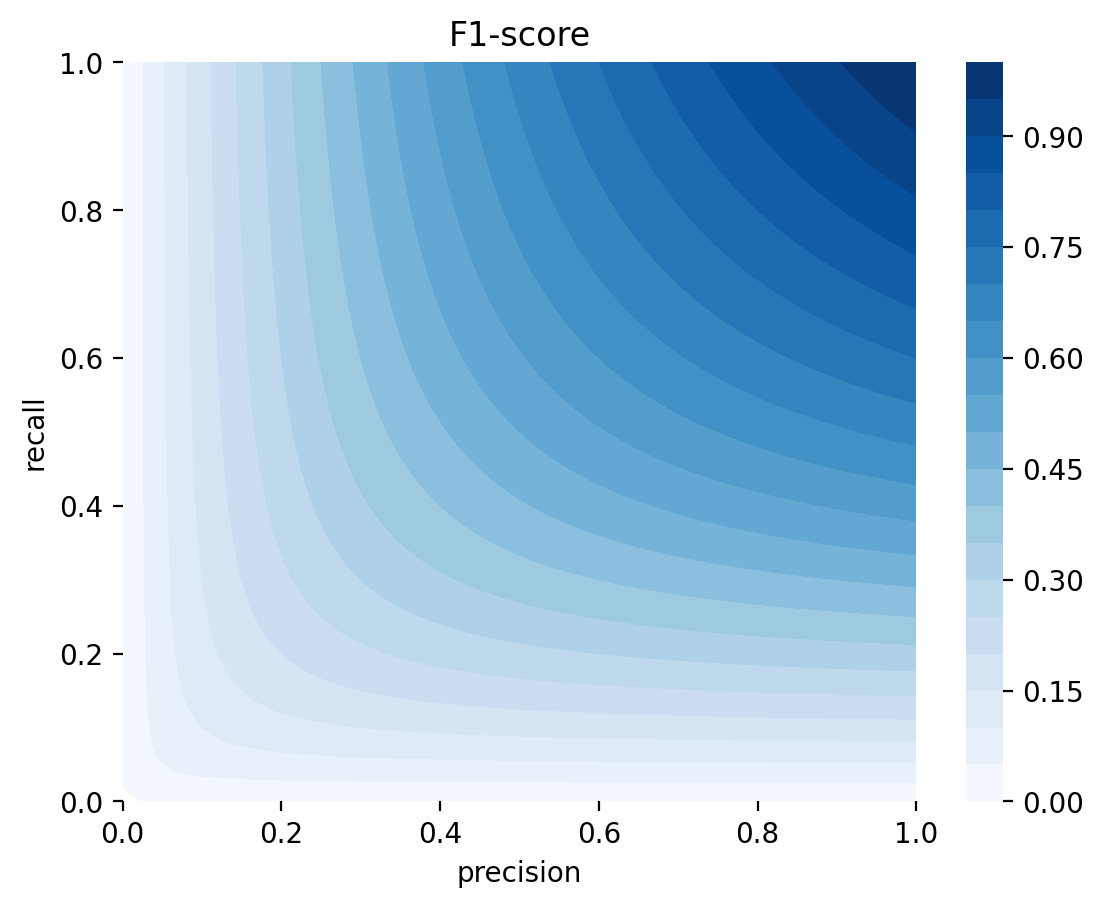
F1-score = \(\displaystyle \left(\frac{\text{precision}^{-1} + \text{recall}^{-1}}{2}\right)^{-1}\)
Precision과 recall의 조화평균
보수적인 지표임. 즉, precision과 recall 중 하나라도 낮으면 F1-score도 낮아짐
종합: 모형평가
1. Classifier로서 전반적인 모형의 성능 vs. 2. 특정 임계치에서의 모형의 성능 vs. 3. 확률모형
Classifier로서 전반적인 모형의 성능을 평가: AUC 등
비용을 고려한 특정 임계치에서의 모형의 성능
잘못된 예측에 대한 비용이 다르다면, 임계치를 조정하여 기대 손실(Expected Loss)을 줄일 수 있음
다음 두 가지 케이스를 보면,
폭우 예측에서 농가의 경제적 손실을 손실(loss)로 가정하면:
Costs: 농작물 피해, 시설물 피해, 펜스 설치비, 노동력 투입 비용 등
Benefits: 농작물 수확 및 판매 수익
거짓 음성(False Negative, “폭우 없음”으로 예측했으나 실제로 폭우 발생)을 낮춰야 하는 경우
폭우 발생 시 피해 규모가 매우 큰 경우
예방 비용보다 피해 비용이 훨씬 큰 경우
예:
수확 직전 과수원(사과, 배, 복숭아 등)
비닐하우스 시설이 폭우에 취약한 농가
침수 시 작물 전체를 잃을 위험이 있는 농가
이러한 경우에는 다소 과도하게 경보를 발령하더라도 큰 피해를 예방하는 것이 경제적으로 유리함
거짓 양성(False Positive, “폭우 발생”으로 예측했으나 실제로 폭우 미발생)을 낮춰야 하는 경우
예방 조치 비용이 매우 큰 경우
실제 폭우가 발생하더라도 피해 규모가 상대적으로 제한적인 경우
예:
폭우 대비를 위해 대규모 인력과 장비를 동원해야 하는 농가
조기 수확 시 상품 가치가 크게 하락하는 고급 과일 농가
배수 시설이나 보호 시설이 잘 갖추어져 있어 폭우 피해가 비교적 작은 농가
이러한 경우에는 불필요한 대응 비용을 줄이기 위해 보다 높은 확률에서만 경보를 발령하는 것이 경제적으로 유리함
정리하면,
폭우 피해 비용 > 예방 비용 → 거짓 음성을 줄이는 방향으로 임계치 조정예방 비용 > 폭우 피해 비용 → 거짓 양성을 줄이는 방향으로 임계치 조정
와인 셀러가 와인의 화학적 성분을 이용하여 품질을 예측하는 모형을 구축하는 경우,
양성(Positive): 고품질 와인
음성(Negative): 저품질 와인
Costs:
거짓 음성(False Negative): 실제로는 고품질 와인인데 저품질로 분류
프리미엄 가격을 받지 못함
고품질 와인을 저가에 판매하여 수익 손실 발생
거짓 양성(False Positive): 실제로는 저품질 와인인데 고품질로 분류
고객 만족도 저하
와인 평론가 및 소비자의 신뢰 상실
브랜드 가치 하락
장기적인 매출 감소 가능성
Benefits:
고품질 와인을 정확히 고품질로 분류
저품질 와인을 정확히 저품질로 분류
거짓 음성(False Negative)을 낮춰야 하는 경우
예:
신생 와이너리
영세 와이너리
브랜드 인지도가 낮은 생산자
이들은 브랜드 가치보다 단기적인 현금 흐름과 수익 확보가 더 중요할 수 있음.
따라서 일부 저품질 와인이 고품질로 분류될 위험을 감수하더라도, 실제 고품질 와인을 놓치지 않는 것이 중요함.
즉, “좋은 와인을 싸게 파는 손실”을 최소화하는 전략
거짓 양성(False Positive)을 낮춰야 하는 경우
예:
프리미엄 와이너리
고급 브랜드 이미지를 가진 생산자
오랜 기간 품질로 명성을 구축한 와이너리
이들은 한 번의 품질 실수가 브랜드 신뢰에 큰 타격을 줄 수 있음.
따라서 일부 고품질 와인이 저품질로 분류되어 수익을 놓치더라도, 저품질 와인이 프리미엄 제품으로 판매되는 상황은 최대한 방지하려 함.
즉, “수익 손실보다 브랜드 가치 보호”가 더 중요한 전략
정리하면,
고품질 와인을 놓쳐 발생하는 수익 손실 > 저품질 와인을 고품질로 분류하여 발생하는 평판 손실 → 거짓 음성(False Negative)을 줄이는 방향으로 임계치 조정저품질 와인을 고품질로 분류하여 발생하는 평판 손실 > 고품질 와인을 놓쳐 발생하는 수익 손실 → 거짓 양성(False Positive)을 줄이는 방향으로 임계치 조정
확률을 정확히 예측하는 모형의 추구
단순히 “양성/음성”을 예측하는 것이 아니라, 사건이 발생할 확률을 정확하게 추정하는 것을 목표로 함
단일 확률값뿐 아니라 그 확률값의 분포 전체 (Bayesian 접근)를 제공하여 예측값의 불확실성까지 전달함
모형은 의사결정을 내리는 것이 아니라, 의사결정에 필요한 정보를 제공하는 역할을 수행함
실제 decision maker는 당사자/소비자
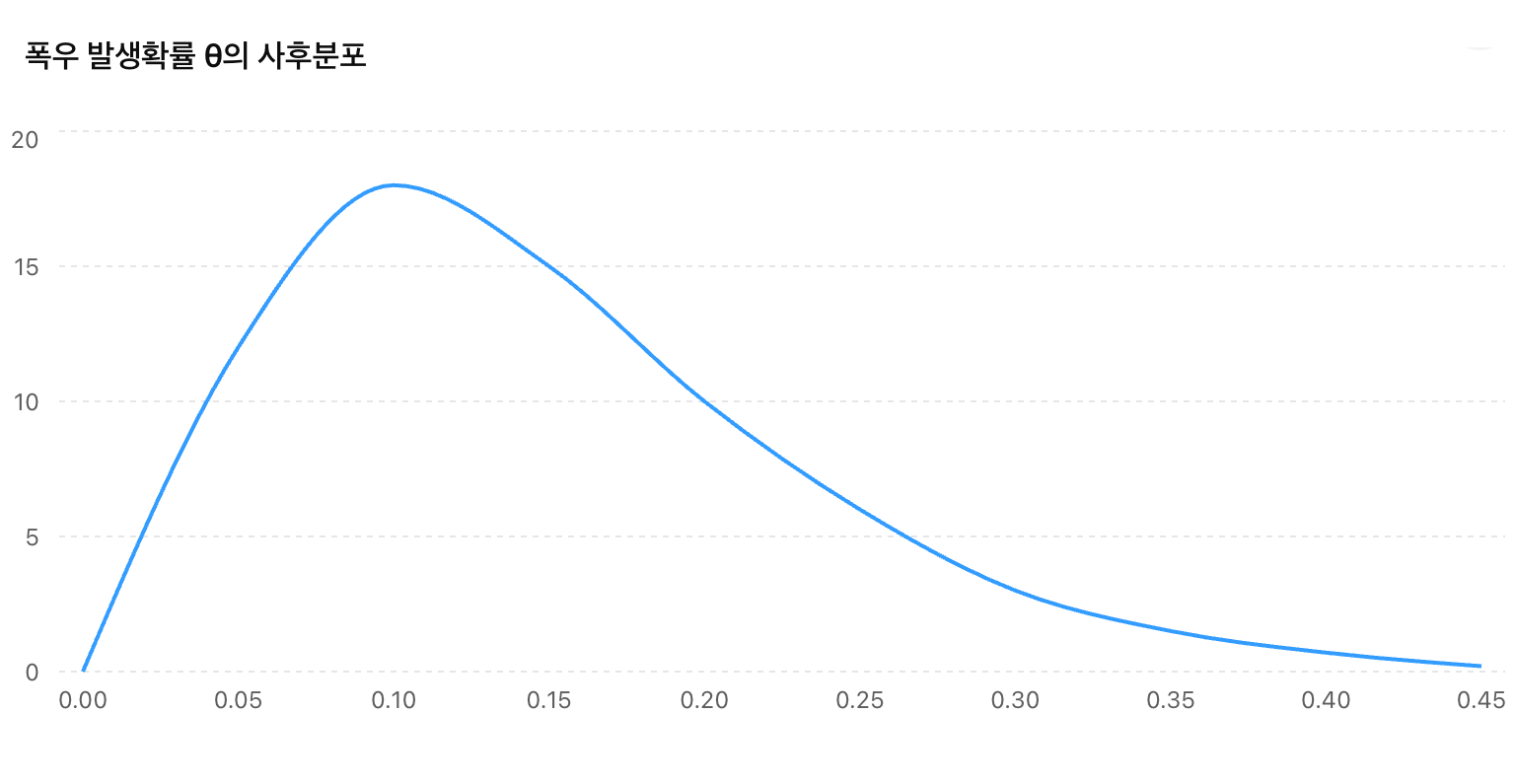
예를 들어, 폭우 예측 문제에서 폭우 발생확률 \(p\) 의 사후분포를 다음과 같이 얻을 수 있음.
가령, 이 분포를 이용해 모든 가능한 \(p\) 에 대한 기대 손실(expected loss)들의 기대값으로 총 손실을 계산할 수 있음
Frequentist 접근에서는 종종 “가장 가능성이 높은 결과”에 주목하지만, Bayesian 접근에서는 예측분포 전체를 이용하여 기대손실(Expected Loss)을 계산하고 의사결정을 수행
Decision Boundary
앞선, Log odds(logit): \(\displaystyle log\left(\frac{\hat{p}}{1 - \hat{p}}\right) = b_0 + b_1 \cdot X\)
Log odds(logit): \(\displaystyle log\left(\frac{\hat{p}}{1 - \hat{p}}\right) = b_0 + b_1 \cdot X_1 + b_2 \cdot X_2\)
또는 \(\displaystyle \hat p = \sigma(b_0 + b_1 \cdot X_1 + b_2 \cdot X_2)\) , \(\displaystyle \sigma := \frac{1}{1 + e^{-x}}\)
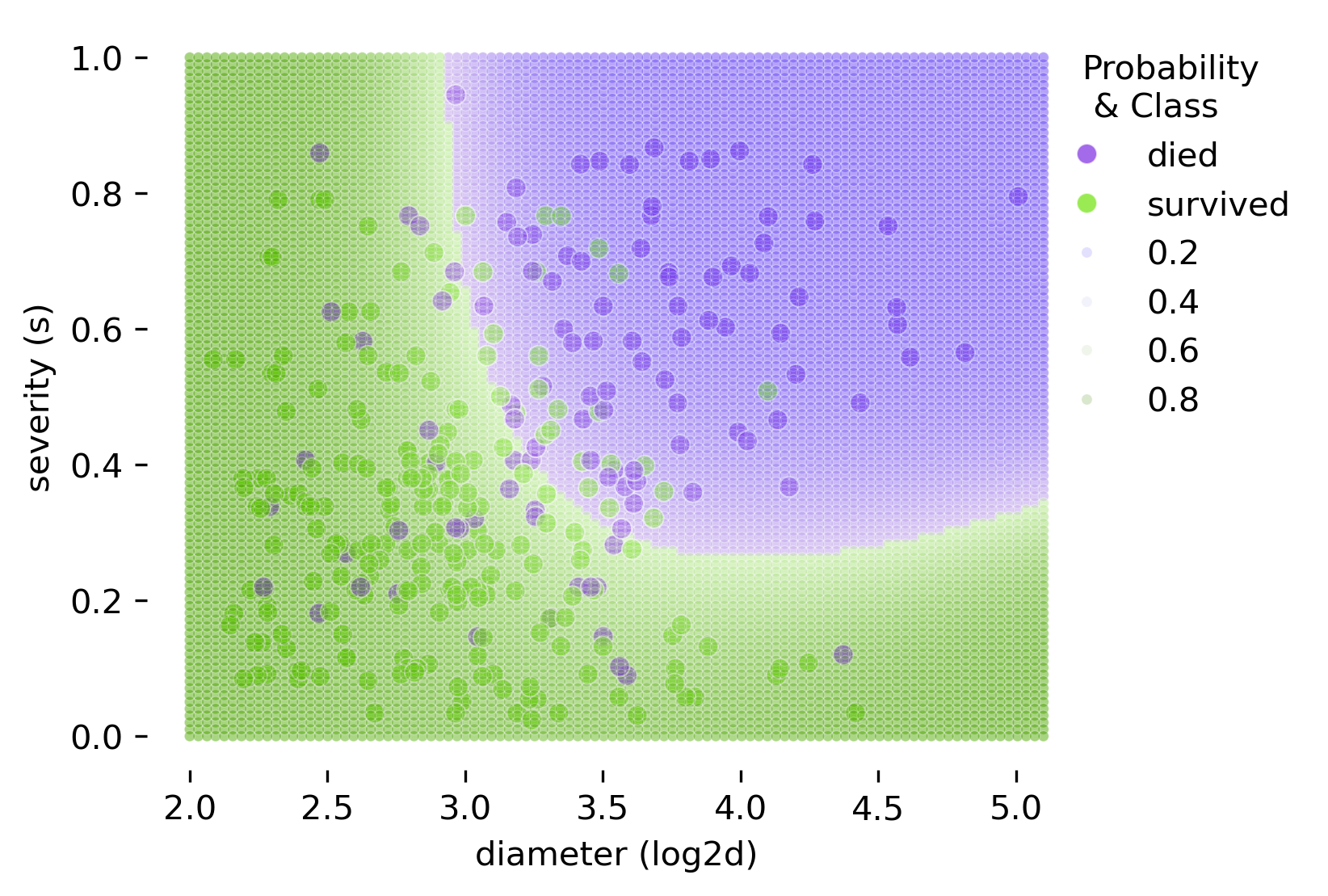
왼편의 logit 함수(또는 sigmoid 함수)는 증가함수이므로, threshold를 정하면 선형 결정 경계(decision boundary)가 나타남: hyperplane
비선형 함수로 모형을 세우면, decision boundary가 비선형으로 나타남.
예를 들어, \(b_0 + b_1 \cdot X + b_2 \cdot X^2\) 등
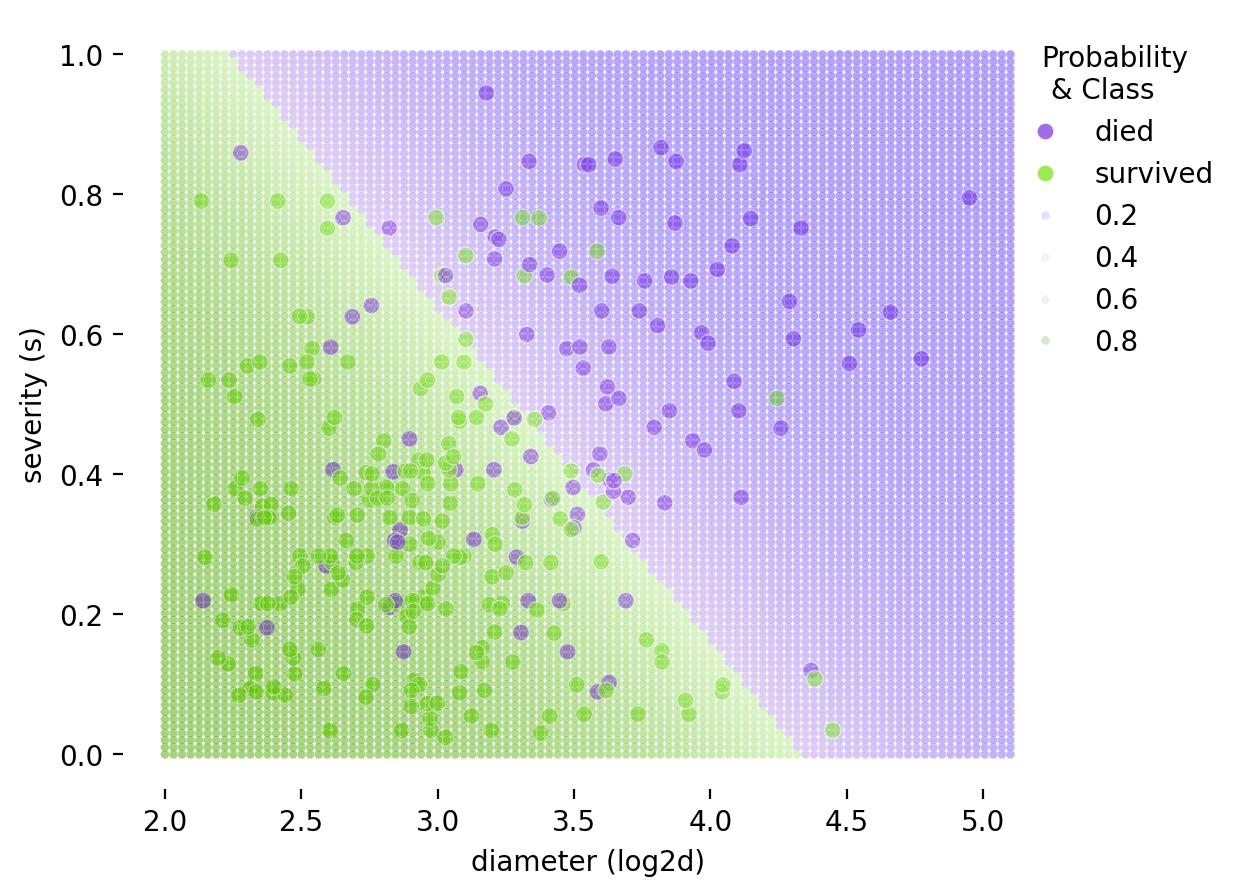
밑은 두 예측변수 \(X_1= log2d\) (diameter)와 \(X_2=s\) (severity)로 나무가 쓰러질지 여부를 선형함수로 만들었을 때의 decision boundary (threshold=0.5)\(\displaystyle log\left(\frac{\hat{p}}{1 - \hat{p}}\right) = b_0 + b_1 \cdot X_1 + b_2 \cdot X_2\)
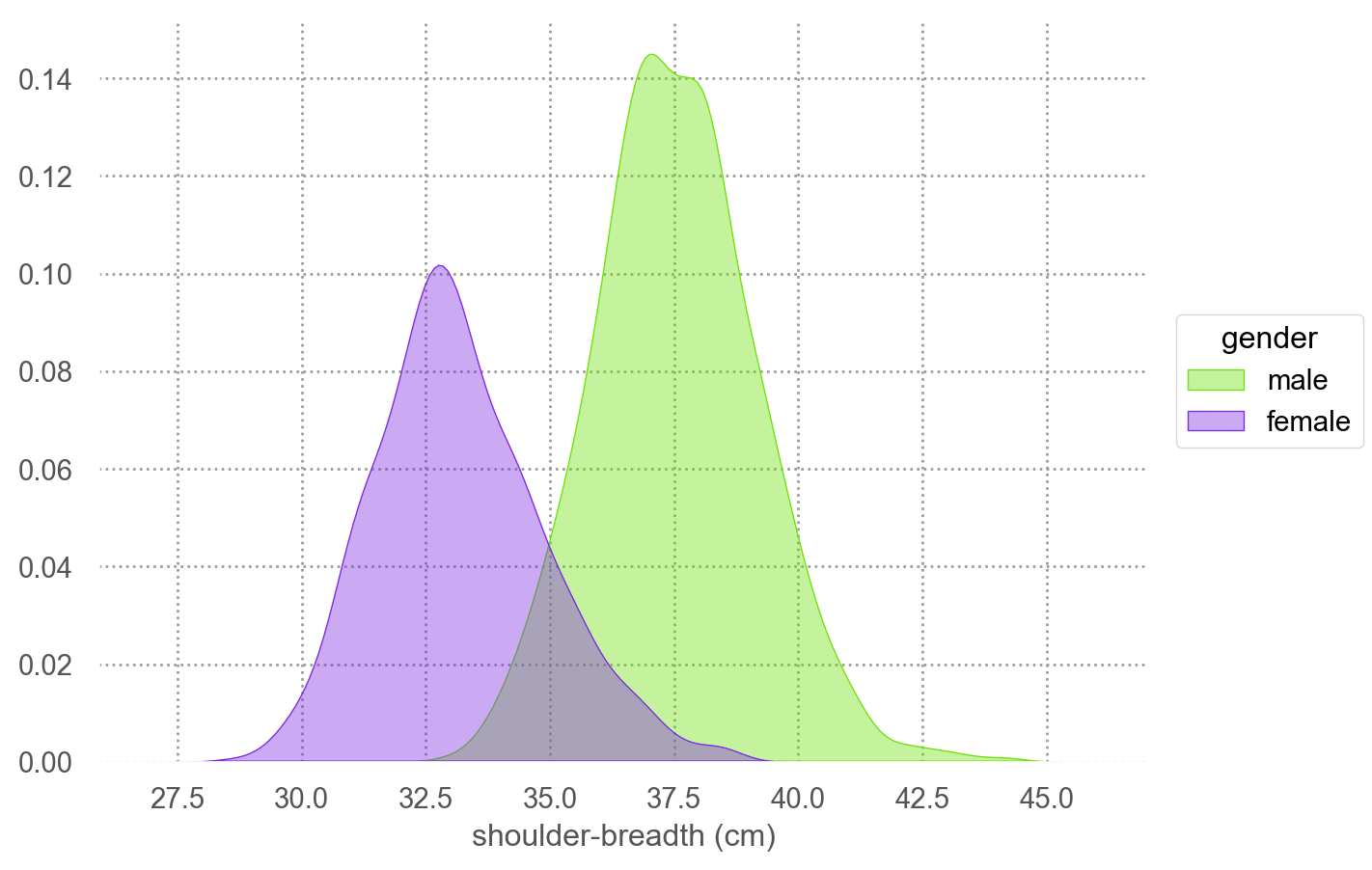
BodyM Dataset
AWS: BodyM Dataset
2,779명 대상으로 8,324장의 정면 및 측면 실루엣 사진과 키, 몸무게, 그리고 14가지 신체 측정치 제공
인종 분포: 백인 40%, 아시아인 30%, 흑인/아프리카계 미국인 14%, 아메리카 원주민 또는 알래스카 원주민 1%, 기타 15%(히스패닉 15%)
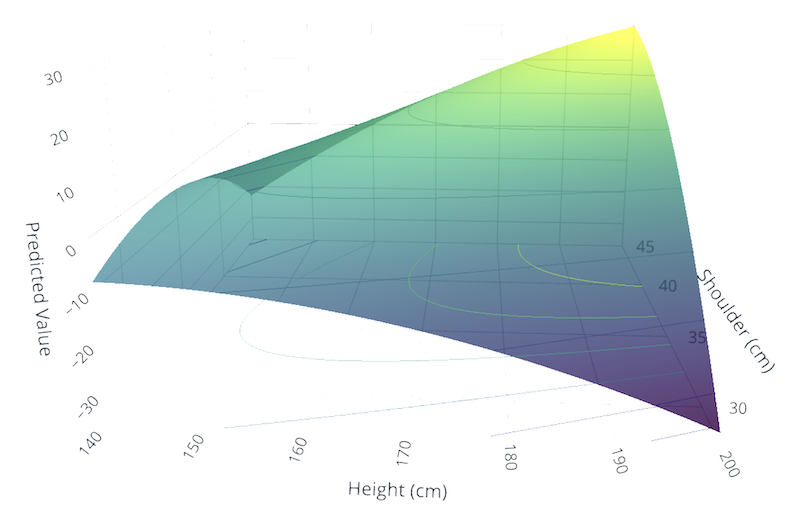
\(Y\) = 성별,\(X_1\) = 키(height), \(X_2\) = 어깨 너비(shoulder-breath)에 대한 2차항을 포함한 선형함수로 모형을 세웠을 때의 decision boundary
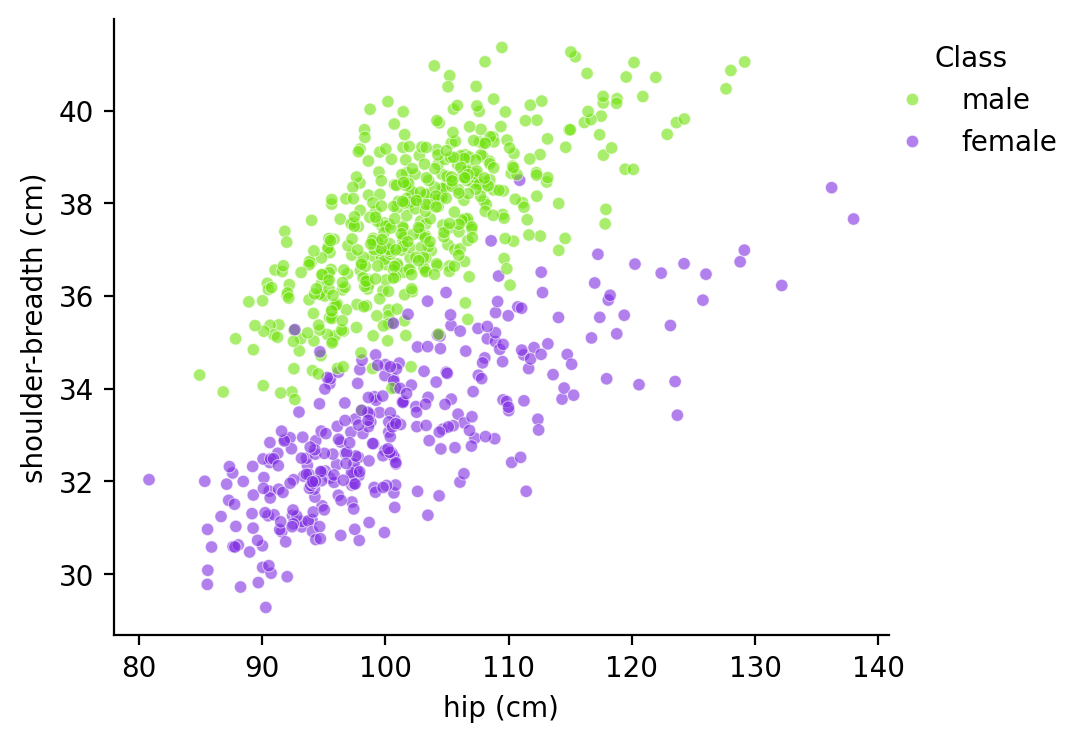
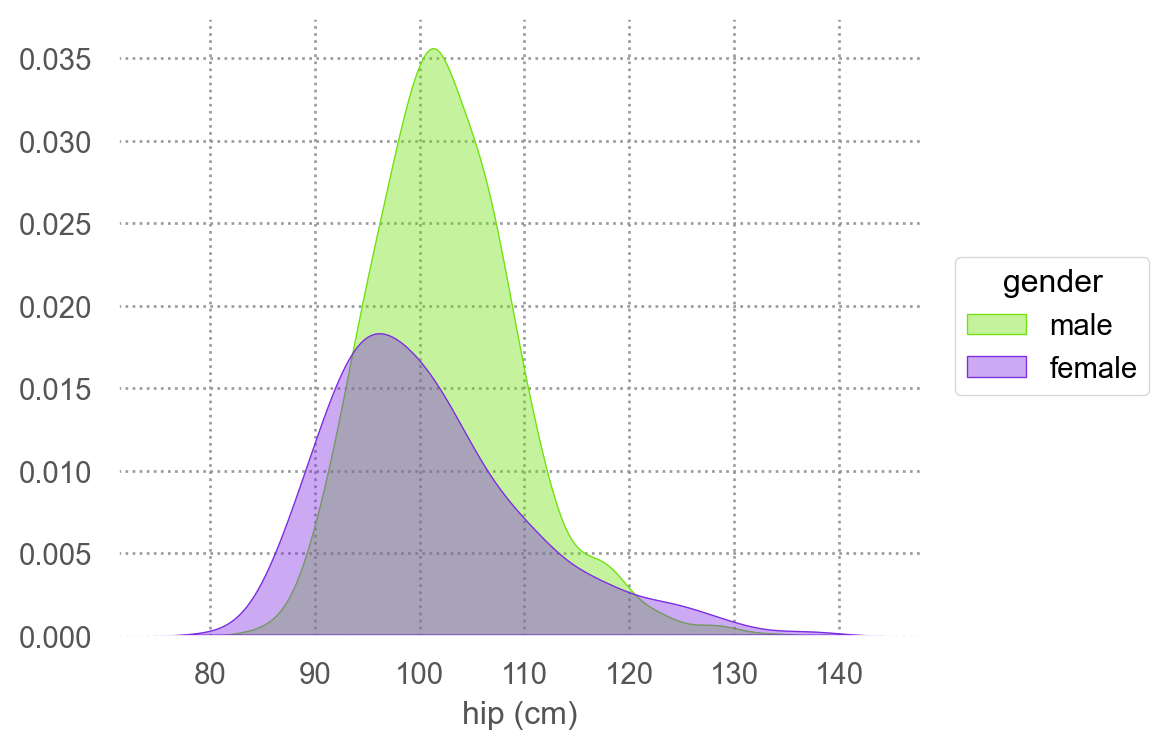
Shoulder와 hip 정보로 분류하다면?